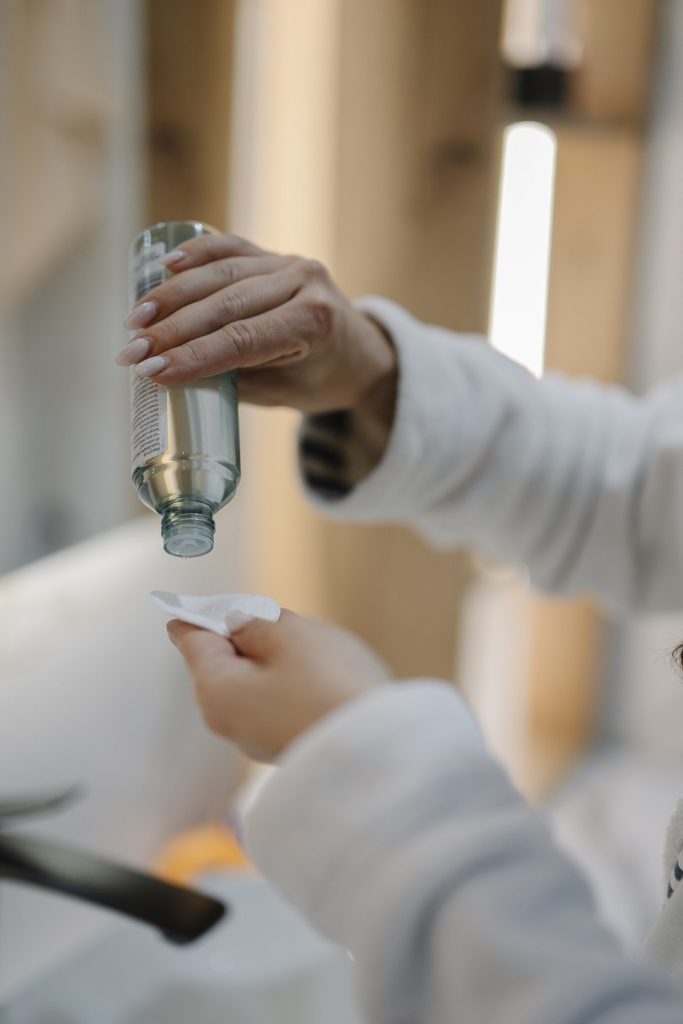
The main skincare products to avoid during pregnancy are retinoid treatments, hydroquinone-based lighteners and high-strength salicylic acid peels. These ingredients do not all carry the same level of concern: retinoids receive the clearest avoid recommendation, while hydroquinone and concentrated salicylic acid are generally skipped because of absorption or dosage concerns and limited pregnancy-specific safety information.
Do not stop a prescription treatment based only on a product list. If you use prescription acne medication or have already applied a concerning ingredient, pause the topical product and contact your prenatal clinician or prescriber with the exact product name and ingredient list. A previous application does not establish that harm occurred.
- What to remove from your routine
- How to recognize retinoids on a label
- When salicylic acid becomes a concern
- Why hydroquinone is usually avoided
- Ingredients that require individual judgment
- How to build a simpler pregnancy skincare routine
- What to do with products you already used
- Sources
What to remove from your routine
Start by checking treatments rather than discarding every cleanser, moisturizer and cosmetic you own. Products marketed for anti-aging, acne, dark spots, brightening or professional-strength exfoliation are more likely to contain ingredients that require attention.
| Product type | Ingredient to check for | Practical action |
|---|---|---|
| Anti-aging serums and night creams | Retinol or another retinoid | Stop during pregnancy and choose a non-retinoid product |
| Prescription acne or anti-aging treatments | Tretinoin or another prescription retinoid | Contact the prescriber for an alternative |
| Dark-spot and skin-lightening products | Hydroquinone | Set aside during pregnancy |
| At-home peels and intensive exfoliants | High-concentration salicylic acid | Avoid unless your clinician specifically approves the treatment |
| Ordinary acne cleansers or spot treatments | Salicylic acid or benzoyl peroxide | Check the concentration and ask your clinician if continued use is appropriate |
| Concentrated essential-oil products | Individual essential oils and dilution level | Avoid assuming that “natural” means pregnancy-safe; review the specific product |
This focused approach matters because most basic skincare products are not automatically unsafe. A short routine also makes ingredient checking easier; a minimalist approach to skincare steps can reduce the number of overlapping treatments you need to evaluate.
How to recognize retinoids on a label
Retinoids are vitamin A derivatives commonly found in anti-aging, texture-refining and acne products. They are the clearest category to remove from a pregnancy skincare routine as a precaution.
Check ingredient lists and prescription labels for names such as:
- Retinol
- Retinal or retinaldehyde
- Retinyl palmitate
- Tretinoin
- Other products explicitly identified as retinoids or vitamin A derivatives
Oral isotretinoin presents a well-established pregnancy risk, while topical retinoids are absorbed in much smaller amounts. Even so, pregnancy guidance generally recommends avoiding topical retinoids rather than trying to calculate exposure product by product. The SoKind pregnancy ingredient overview explains this precautionary distinction between oral and topical exposure.
The practical rule is straightforward: if a serum, cream or acne treatment contains a retinoid, stop using it during pregnancy. If it is prescribed, ask the prescriber what to use instead rather than substituting another strong acne active on your own.
When salicylic acid becomes a concern
Salicylic acid requires more nuance than retinoids. The concentration, product format, treatment area and frequency of use all affect the decision.
High-dose products—especially chemical peels and intensive treatments—are best avoided during pregnancy. By contrast, the SoKind ingredient guidance describes the concentrations below 2% found in many over-the-counter products as generally low risk.
That does not mean every low-strength salicylic acid product is automatically suitable for every pregnancy. A cleanser that is rinsed off is not the same exposure as a leave-on peel applied over a large area. If the label does not show a concentration—or if you use several exfoliating products at once—ask your clinician or pharmacist to review the routine.
A useful decision rule is:
- Professional-strength peel or intensive at-home peel: avoid.
- Large-area or frequent leave-on treatment: seek individual guidance.
- Low-concentration cleanser or occasional small-area product: do not treat it as equivalent to a peel, but confirm continued use if uncertain.
Why hydroquinone is usually avoided
Hydroquinone is used in products intended to lighten dark spots, including treatments for melasma and other forms of hyperpigmentation. It is usually avoided during pregnancy because a meaningful amount can be absorbed through the skin while pregnancy-specific safety evidence remains limited.
The concern is therefore not proof that a normal topical use causes a particular outcome. It is an exposure-and-uncertainty decision: when a nonessential cosmetic treatment has relatively high absorption and insufficient pregnancy data, postponing it is the more cautious option. A hydroquinone pregnancy overview similarly recommends avoiding the ingredient because of its absorption.
Look for hydroquinone in products labeled as skin lighteners, fading creams, bleaching creams or dark-spot correctors. If pregnancy-related pigmentation is the reason you use it, discuss alternatives with your clinician rather than replacing it with an unfamiliar lightening product that may contain the same ingredient under less prominent labeling.
Ingredients that require individual judgment
Some pregnancy skincare lists place benzoyl peroxide, chemical sunscreen filters, parabens, phthalates, synthetic fragrance and all essential oils into one broad “avoid” category. The strength and specificity of those recommendations are not equal, so they should not be treated as though they carry the same established concern as retinoids.
Benzoyl peroxide
Benzoyl peroxide is common in acne cleansers and spot treatments. Some clinicians recommend avoiding it out of caution, while pregnancy recommendations can vary. The Vogue overview of pregnancy skincare presents a cautious recommendation to avoid benzoyl peroxide, but that should be understood as a clinical preference rather than evidence that every exposure causes harm.
If benzoyl peroxide is controlling significant acne, ask your prenatal clinician or dermatologist before replacing it. Switching indiscriminately could lead to using a stronger or less suitable active.
Fragrance and essential oils
Fragrance can be relevant because pregnancy may coincide with greater skin sensitivity or scent intolerance, not because every fragranced moisturizer creates the same pregnancy risk. If a product causes redness, itching, burning or nausea, stop using it and select a simpler fragrance-free option.
Essential oils also cannot be assessed as one uniform ingredient. Safety depends on the particular oil, concentration and route of use. Even guidance that permits properly diluted oils identifies certain oils for additional caution during pregnancy. Avoid ingesting essential oils or applying concentrated oils as DIY skincare, and have a clinician review a specific product if you are unsure.
Chemical sunscreen filters, parabens and phthalates
A hospital-affiliated overview lists chemical sunscreens, parabens and phthalates among ingredients to avoid during pregnancy (Southwest General). However, a category-wide list does not show that every product, filter or exposure has an identical risk.
If you prefer to minimize uncertainty, choose a product with a shorter ingredient list that meets your needs and can be reviewed easily. Do not respond by skipping sun protection altogether, particularly if pigmentation is a concern; ask your clinician to recommend a sunscreen format appropriate for pregnancy and your skin.
How to build a simpler pregnancy skincare routine
Once retinoids, hydroquinone and strong salicylic acid treatments are removed, focus on what your skin currently needs instead of trying to replace every active ingredient.
A basic routine can consist of:
- A gentle cleanser
- A straightforward moisturizer
- A clinician-approved sunscreen for daytime use
- A targeted treatment only when there is a clear need and its pregnancy suitability has been checked
For dryness or sensitivity, uncomplicated moisturizing ingredients may be more useful than additional exfoliation. Shea butter, aloe vera, jojoba oil, oat extracts and hyaluronic acid are identified as moisturizing or soothing options in the SoKind pregnancy skincare guide.
Still evaluate the complete formula. A product advertised around hyaluronic acid, for example, could also contain a retinoid or another active ingredient. The front label tells you how a product is marketed; the full ingredient list tells you what you are applying.
Introduce any replacement one at a time. Pregnancy can coincide with dryness and sensitivity, so adding several new products at once makes it harder to identify the cause if irritation develops. Burning, persistent redness, swelling or worsening rash are signals to stop the new product rather than continuing in the hope that your skin will “adjust.”
What to do with products you already used
If you discover that a product contains an ingredient you intended to avoid, do not assume that topical use has harmed the pregnancy. The appropriate next step is to stop the nonessential product and gather specific information:
- Product name and brand
- Full ingredient list
- Active-ingredient concentration, if shown
- How often you used it
- Where and how much you applied
- Whether it was prescription or over the counter
Bring those details to your prenatal clinician, pharmacist or prescriber. This allows them to assess the actual product and exposure rather than responding to a broad category name.
For prescription retinoids or other medicated treatments, contact the prescriber promptly. For an ordinary cosmetic that was used once or occasionally, retain the packaging and ask about it at the next appropriate clinical contact rather than drawing conclusions from the ingredient name alone.
The most useful immediate step is to audit your anti-aging, acne, peeling and dark-spot products first. Remove retinoids, hydroquinone and high-strength salicylic acid treatments, then have any uncertain medicated products reviewed before continuing them.
Sources
- What Skincare Ingredients to Avoid During Pregnancy, and What to Use Instead — SoKind
- Beauty Products to Avoid While Pregnant — Southwest General
- A Definitive Guide to What Skincare Products to Avoid While Pregnant — Vogue
- 6 Skincare Ingredients to Avoid During Pregnancy — withSimplicity