Disclaimer: This guide on simplify skincare ingredients without starting over is for general education only and is not medical advice or a medical diagnosis. If you have burning, swelling, a rash, eye pain, vision changes, or symptoms that keep coming back, talk with a dermatologist, doctor, or qualified clinician.
Learning how to simplify skincare ingredients without starting over does not mean discarding everything or abandoning ingredients that already help. Protect the comfortable essentials, identify products that duplicate a function or create problems, and pause optional layers in a controlled order. The aim is a routine you can tolerate, follow, and evaluate – not merely the fewest possible bottles.
The First Step
Identify when simplify skincare ingredients without starting over goes wrong, return to the last stable setup, and pause any change that turns inconvenience into damage or pain. Outside help is safer if burning, swelling, spreading redness, or unusual breakouts keep worsening after the newest change is removed.
Protect the Products That Keep the Routine Functional
A useful core gives every retained product a distinct responsibility. Write one primary job beside each item you use:
- Remove sunscreen, makeup, excess oil, or debris when cleansing is needed.
- Reduce dryness, tightness, or friction.
- Protect exposed skin from ultraviolet radiation during the day.
- Follow a prescription or clinician-directed treatment plan.
- Address one clearly defined cosmetic concern, such as acne, discoloration, or texture.
- Add no function that another retained product does not already cover.
The final category is the clearest place to subtract. Two products can feature different headline ingredients while serving the same purpose. A brightening toner and a discoloration serum, for example, may both be optional treatments for the same concern. Keeping both is reasonable only if each has a clear role, the combination is tolerated, and the schedule remains manageable.
Conversely, seeing the same ingredient name on two labels does not prove that the formulas are interchangeable. Concentration, acidity, vehicle, supporting ingredients, application area, and intended frequency can change how a product behaves. A cleanser containing an active ingredient has brief contact with the skin, while a leave-on formula creates a different exposure.
Do not remove protective basics merely to preserve every intensive treatment. Continuing a retinoid and multiple exfoliating acids while dropping moisturizer may shorten the product list but increase dryness and irritation. A simpler routine should be easier to tolerate as well as easier to remember.
Prescription products require special handling. Keep using them according to the prescriber's directions unless that clinician advises otherwise. If a prescription appears connected to new symptoms, contact the prescriber rather than changing its strength, schedule, or combination on your own.
Find the Overlap, Damage, or Application Failure
Before eliminating an ingredient category, determine whether the problem comes from excessive exposure, a deteriorated formula, duplicated functions, or the way products are layered.
Start with the package and ingredient list. Record the stated purpose, active ingredients, application directions, frequency limits, expiration information, period-after-opening symbol, and storage requirements. Set a product aside if it is beyond a stated use limit, was stored against its directions, or may have been contaminated.
Do not apply a questionable formula to already irritated skin merely to confirm that it has gone bad.
Compare the current color, odor, and consistency with the product description and manufacturer guidance. Unexpected separation, a distinctly changed smell, visible contamination, or a major texture change can indicate instability. L-ascorbic acid serums, for instance, can oxidize, although their original colors vary. A shift toward dark orange or brown alongside odor or texture changes deserves more caution than color alone.
Next, separate cosmetic application failures from skin symptoms:
- Pilling, rolling, streaking, or makeup disruption may come from excess product, vigorous rubbing, incompatible textures, or insufficient settling time.
- Greasy or heavy residue can reflect the amount applied or too many occlusive layers.
- Stinging, itching, swelling, persistent redness, cracking, or raw patches are skin symptoms, not ordinary layering inconveniences.
- New clogged pores or breakouts may relate to a product, but their timing and cause can be difficult to establish without clinical assessment.
Pilling does not automatically mean two active ingredients are chemically incompatible. Apply smaller amounts, spread each layer without prolonged rubbing, and allow the surface to settle before adding the next formula. If the same optional product continues to disrupt sunscreen or makeup, move it to an evening routine or pause it.
Daytime sun protection should not be compromised to preserve a nonessential serum.
Blanket ingredient-pairing lists can also mislead. Niacinamide and L-ascorbic acid, for example, are not universally forbidden together. Finished formulas may be designed to coexist, and some people tolerate separate products in the same routine. Total active load, formulation, frequency, and individual sensitivity are more useful decision factors than a rule based only on two ingredient names.
Consider a routine containing glycolic acid, salicylic acid, a retinoid, a low-pH vitamin C serum, moisturizer, facial oil, and sunscreen. Every optional active may have a stated purpose, yet the combined schedule can make the source of dryness impossible to identify. The problem is not necessarily one inherently bad ingredient.
It may be overlapping exfoliation, frequent application, or too many leave-on treatments competing for limited tolerance.
Change the Crowded Routine Without Erasing What Works
Controlled subtraction preserves useful products while making the routine easier to read. Use the following actions in order rather than removing and replacing several items at once.
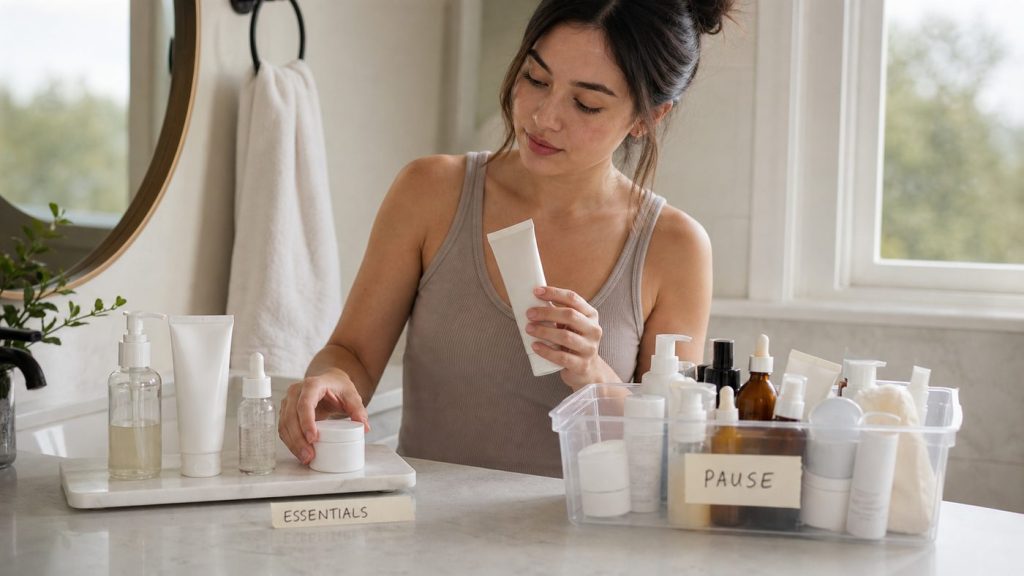
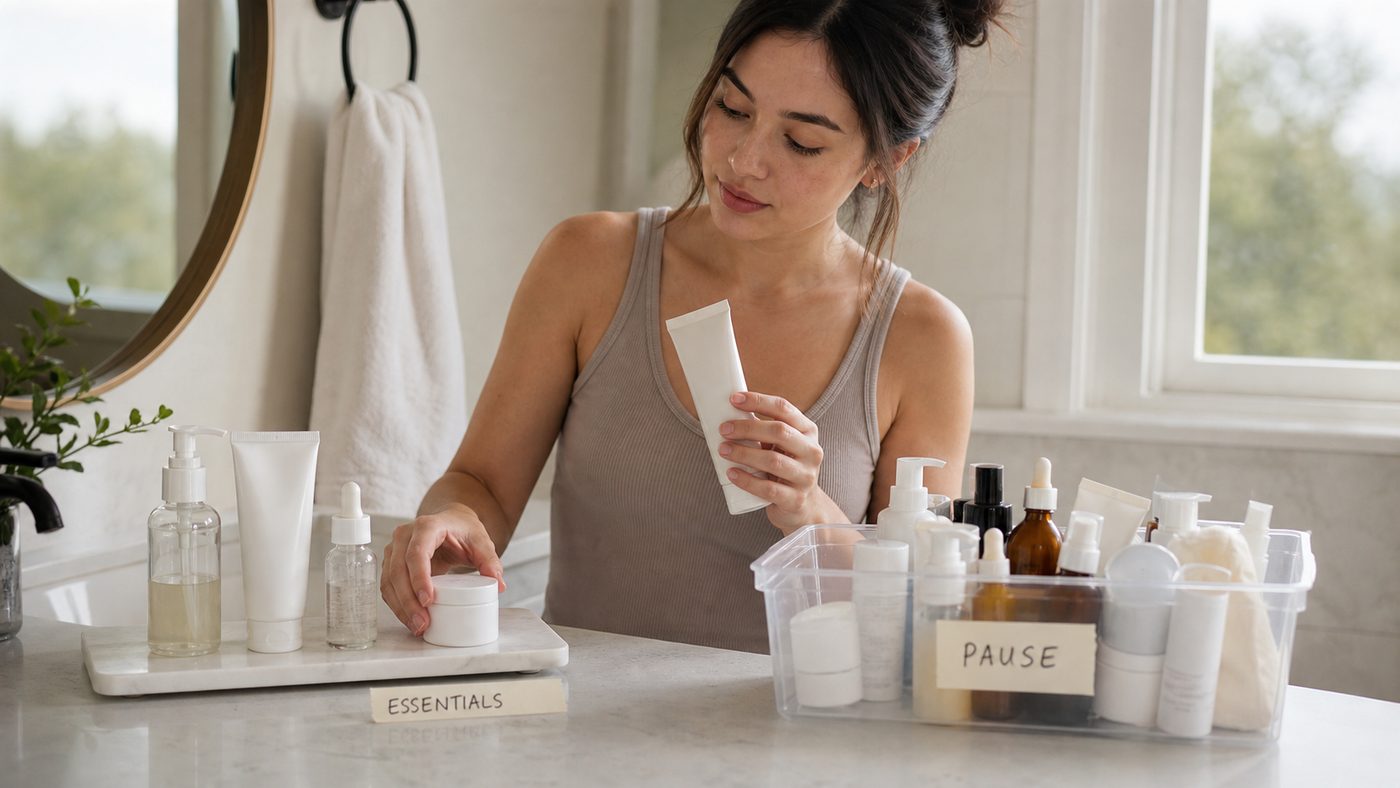
- Place every routinely used product in one visible lineup before the next application, then photograph the front and ingredient labels while they are legible. Include occasional masks, spot treatments, and exfoliants; otherwise, hidden products can continue contributing to symptoms.
- Write one primary job beside each product, using its label directions and your actual reason for applying it. If two optional leave-on products target the same concern, circle both and retain only the one that has been comfortable, stable, and easier to use while you evaluate the routine.
- Record each application during a representative week without increasing any frequency to make the record look complete. Note the amount in practical terms, the time of day, the application area, and any pilling or skin symptoms. The schedule you actually follow matters more than the schedule you intended to follow.
- Keep the comfortable core in place whenever those products are not suspected of causing harm. Continue cleansing only as needed, apply a non-stinging moisturizer, use sunscreen according to its label, and follow clinician-directed treatment instructions. Avoid introducing an unfamiliar replacement during this period.
- Pause the optional product with the strongest reason for removal, then store it according to its label instead of discarding it immediately if it remains usable. Start with a new addition linked to symptoms, a duplicate exfoliant, an altered formula, or a layer that repeatedly disrupts sunscreen. Do not fill the empty step with another active.
- Reduce the amount and rubbing when the only failure is pilling, but stop this adjustment if discomfort appears. Apply a thin, even layer to dry skin, allow it to settle, and add the next product with minimal friction. If ordinary applications still roll or streak, separate the products by routine or omit the optional layer.
- Wait until the skin has returned to its usual comfort before considering an optional product again, and follow the product's labeled frequency rather than compensating for missed applications. Reintroduce only one paused formula while keeping the rest of the routine unchanged. Do not bring back an acid, retinoid, and low-pH serum together.
- Compare the simplified routine with the written record after several ordinary uses, focusing on comfort, adherence, and the original skin concern. Keep a paused product out if its absence improves comfort without removing an essential function. Seek professional guidance if symptoms continue despite removing the suspected trigger.
Product order should follow label directions and formulation needs rather than a universal diagram. Water-based layers often spread more easily before creams or oils, and sunscreen generally belongs at the end of morning skincare and before makeup. However, some medications require dry skin, restricted frequency, or a particular position in the sequence.
Simplification may require no new purchase. Existing products can remain if they are stable, within their use period, comfortable, and responsible for distinct functions. Consider replacement only when an essential function is missing, a basic product repeatedly causes symptoms, or a qualified clinician recommends a different treatment category.
Why a Shorter Shelf Can Still Leave Skin Overworked
The number of products does not reveal the routine's total intensity. Three frequently applied treatments can be harder to tolerate than six mild products with separate functions. Ingredient concentration, formulation, frequency, application amount, and the condition of the skin barrier all influence the outcome.
Avoid these common failures:
- Do not label diffuse burning, swelling, or raw patches as purging. Some acne treatments can temporarily alter breakout patterns, but escalating irritation should not be normalized.
- Do not add several soothing or "barrier" products while investigating a reaction. New formulas add new variables and can obscure the original trigger.
- Do not assume that a higher percentage is automatically more effective or appropriate for your skin.
- Do not mix finished products in a separate container to dilute them, alter their pH, or improve their texture.
- Do not restore every paused product as soon as visible redness fades.
- Do not keep an expired, contaminated, or substantially altered formula solely to avoid waste.
The American Academy of Dermatology's acne guidance explains that acne treatments can require time, but treatment expectations do not justify ignoring severe or persistent reactions. Distinguishing an expected adjustment from irritation can be difficult, particularly when several active products were started close together.
A paused formula does not always require immediate disposal. Close it securely, mark when it was opened if that information is known, and follow its storage directions. Dispose of it when its use period has passed, its condition has changed, contamination is possible, or reuse repeatedly corresponds with symptoms.
Real-world constraints matter. Someone who must apply makeup quickly may be unable to wait between several film-forming layers. A person with eczema, rosacea, acne treatment, or occupational exposure may have less tolerance for experimentation. In those situations, reliability and clinical compatibility matter more than preserving every optional step.
Symptoms That Make Home Troubleshooting the Wrong Tool
Arrange a non-emergency clinical assessment when irritation keeps returning, acne becomes painful or begins to scar, symptoms persist after suspected products are removed, or you cannot maintain a prescribed treatment because of side effects. A dermatologist or other qualified clinician may need to evaluate contact dermatitis, medication intolerance, infection, eczema, rosacea, acne, or an unrelated condition.
Prepare useful information for the appointment:
- Photograph clear ingredient lists and package directions.
- Record when products were started, stopped, or used more frequently.
- Note where symptoms appeared and whether they spread.
- List prescription and nonprescription treatments used on the area.
- Save dated photographs if the appearance changes before the visit.
The FDA's cosmetics information explains cosmetic safety oversight and provides a route for reporting serious adverse events in the United States. Reporting does not replace medical care, but it can be appropriate when a cosmetic appears connected to a significant reaction.
While waiting for advice, avoid home peels, concentrated essential oils, abrasive tools, unfamiliar acids, and attempts to neutralize one formula with another. Keep questionable products away from broken skin and the eyes. Do not independently change the strength or schedule of a prescription.
Back to top