What to Do First: Pick Your Retinol Format
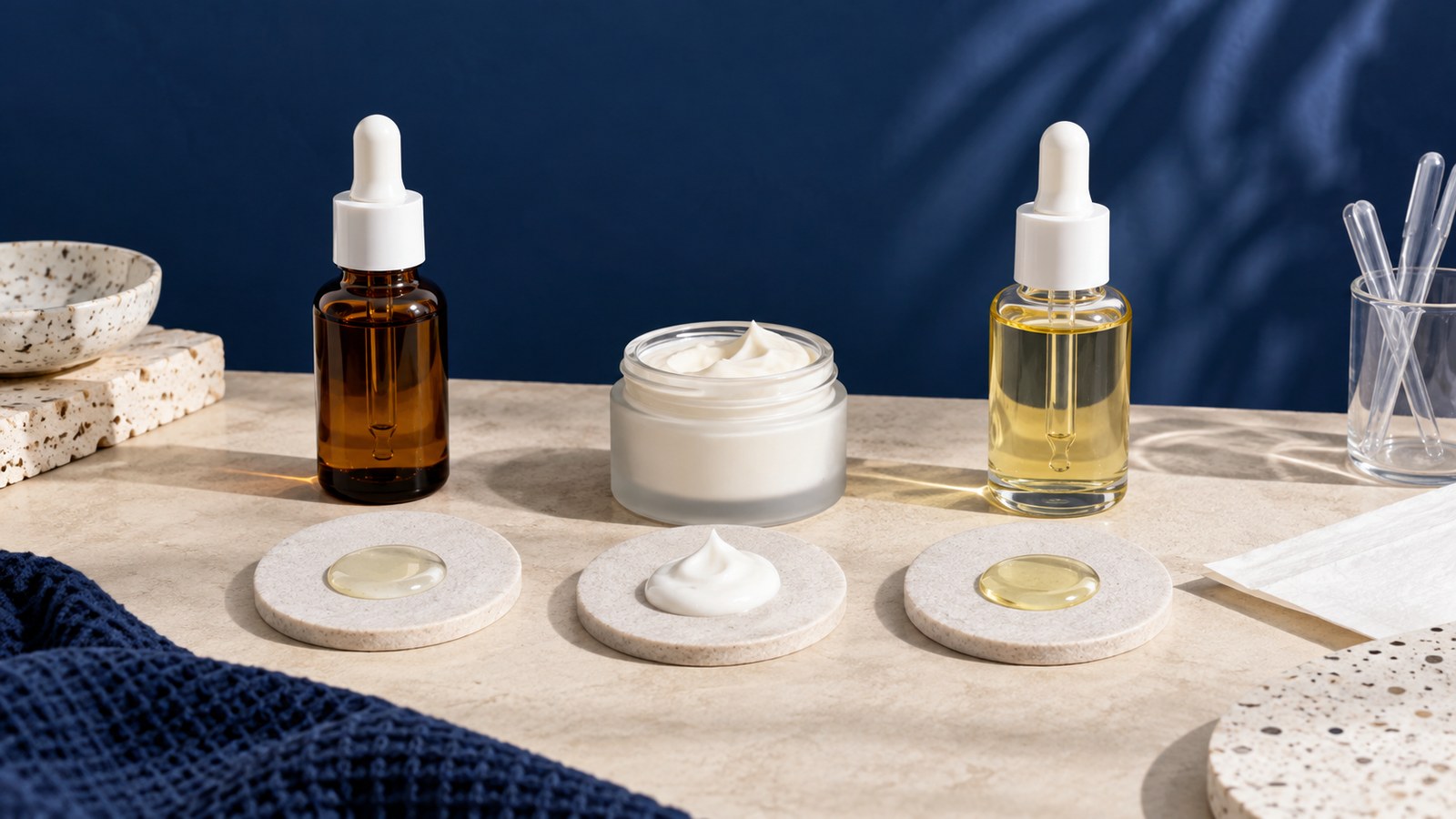
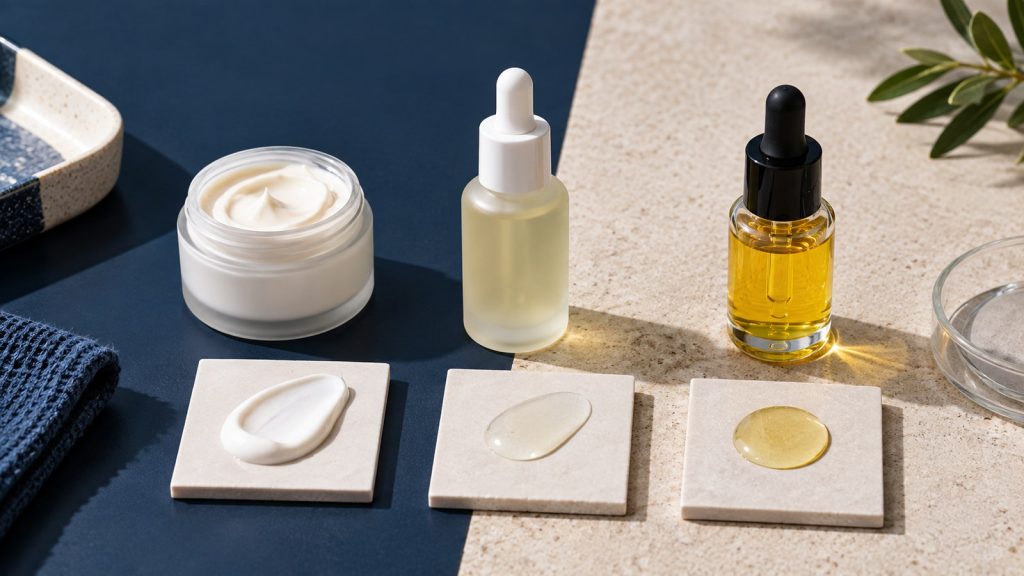
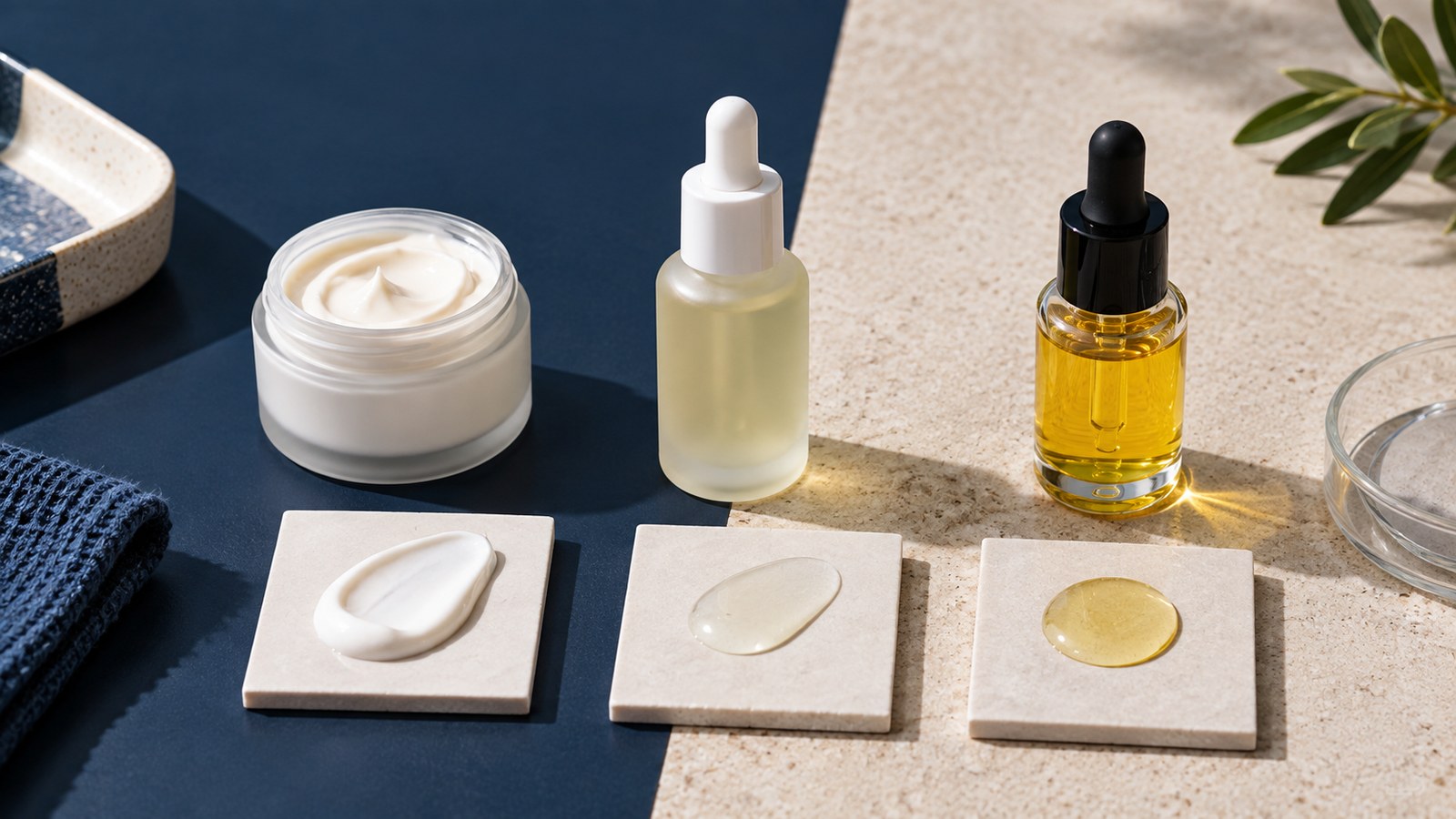
The best skincare with retinol is a clearly labeled cream, serum, or oil whose supporting ingredients, texture, and directions fit your preferences – not automatically the formula advertising the largest percentage. Compare retinol creams with serums first: a cream combines retinol with a moisturizing base. While a serum offers a separate formula to pair with skincare you already like. Oils are another option when you specifically prefer an oil-based finish.
This is general cosmetic guidance limited to ingredient selection and use, not an individual determination of suitability. Individual responses vary, and product labels take priority over general suggestions here.
Choose your preferred base before comparing promotional claims. A cream may simplify your ingredient selection by combining functions. A serum allows you to choose the retinol formula independently of your moisturizer. An oil makes sense when its carrier ingredients and finish appeal to you, not because oil automatically means gentler.
Then verify the ingredient identity. “Retinoid” describes a broader family; “retinol alternative” may describe an entirely different ingredient. A “retinol complex” may be a mixture rather than a statement of the amount of retinol itself. These are not interchangeable comparison points.
Format is only a starting filter. A creamy serum may resemble a light cream, while another serum may be predominantly oil-based. The complete ingredient declaration and directions matter more than the format name. They can establish a documented fit, but cannot predict your individual response.
How Retinol Products Earned Shortlist Spots This Round
This comparison shortlists formula characteristics, not individual products. No supplied product-level testing supports named winners, texture ratings, or claims of superior tolerance. The selection method therefore rests on information you can verify: ingredient identity, supporting composition, directions, and packaging specifications.
A candidate deserves closer consideration when its documentation answers the questions that affect your choice. Apply the same criteria to creams, serums, and oils rather than giving one format an automatic advantage:
- Identifiable retinol: The ingredient declaration explicitly includes retinol, rather than leaving you to infer it from the product name.
- Relevant supporting ingredients: The base contains ingredients you want without those you have specifically decided to omit.
- Understandable active combinations: Other featured actives are named clearly enough to compare with your existing skincare.
- Usable directions: Application instructions and any combination restrictions are available and understandable.
- Practical packaging: Net contents, dispenser type, and relevant storage information are documented.
The FDA’s cosmetics information explains cosmetic labeling and ingredient declarations. For this comparison, that supports reading the complete declaration rather than treating a front-label ingredient highlight as a description of the whole formula.
Exclude a candidate from a confident comparison when essential information is missing or contradictory. This is an evidence boundary, not proof that the formula is poorly made. An undisclosed concentration prevents a precise percentage comparison, but need not prevent comparison of a clearly documented base and ingredient list.
Reviews have a narrower role. Comments about lingering residue or difficult dispensing can suggest questions worth asking. They do not establish retinol concentration, finished-formula stability, or universal compatibility. Even repeated descriptions of a “gentle” texture cannot determine whether the complete formula will suit you.
When two options appear similar, prefer clearer answers to your actual priorities over a longer list of promotional features.
Retinol Creams, Serums, and Oils by Skin Type
Skin-type wording is useful here only as shorthand for formula preferences. It does not replace reading ingredients or require you to classify your skin. Keep the comparison focused on richness, residue, supporting ingredients, and compatibility with products you intend to retain.
If richer textures appeal to you, examine cream bases. Look at how the formula combines ingredients such as glycerin, emollients, and oils rather than judging it by thickness alone. A combined retinol cream may fit when you want a moisturizing base without adding another separate product. Its richness does not establish lower irritation potential.
If you prefer lighter layers, examine fluid serums. The useful fit signal is a base and finish that complement your existing moisturizer. “Serum” is not a reliable synonym for watery or weightless: formulas can be creamy, silicone-rich, or oil-based. A detailed texture description is more helpful than the category name alone.
If you enjoy an oil finish, compare carrier ingredients. An oil-based product may match your preferred slip, but it is a weaker fit if you dislike a lingering film. Review aromatic ingredients separately. Botanical language does not establish that a formula is fragrance-free or suitable for every person.
If minimizing optional actives matters most, compare across formats. A straightforward serum may be easier to assess than a cream combining retinol with several exfoliating ingredients. The reverse can also be true. Formula complexity, not whether the container says cream or serum, changes that decision.
Consider a hypothetical failed attempt: a fluid retinol serum seemed ideal for keeping a favorite moisturizer, but the pair left an unwanted film. Choosing another product solely because it says “lightweight” would repeat the same uncertain comparison. Instead, compare the replacement’s base and finish description.
A different serum base or a combined retinol cream may better match the preference, although the label cannot identify which ingredient caused the original layering issue.
Niacinamide is optional rather than a requirement for retinol skincare. If omitting it is part of your selection criteria, use the guide to choosing skincare without niacinamide as an ingredient-list filter. Its presence or absence does not decide the quality of the remaining formula.
Retinol Texture, Fragrance, and Packaging Tradeoffs
Every format involves a compromise. A rich cream combines functions but may leave more residue than you want. A serum preserves independent choice of moisturizer while adding another formula to evaluate. An oil offers a distinct finish that may not suit your preferred layering textures. None of these tradeoffs establishes a universal winner.
Supporting ingredients deserve the same scrutiny as retinol. A formula containing moisturizing ingredients may have an appealing base, but their presence cannot guarantee comfort. Likewise, more featured actives do not automatically improve ingredient fit. Additional exfoliating ingredients introduce another variable when your goal is specifically to compare retinol.
Decide separately whether you want added fragrance. The American Academy of Dermatology’s skincare guidance distinguishes fragrance-free selection from relying on “unscented” wording, which does not necessarily exclude fragrance ingredients. Read the declaration alongside the claim rather than treating a faint smell as proof of their absence.
Packaging has handling tradeoffs as well as visual ones. An opaque pump may be convenient, but its appearance cannot prove the finished formula’s stability. A dropper requires opening and closing the bottle each time. A jar provides broad access but may not make the stated application amount easier to interpret.
A physical limitation can outweigh an otherwise appealing ingredient list. If you cannot comfortably control a dropper or close its bottle as directed, a manageable pump or tube may be a better fit. Check the actual dispenser rather than assuming all pumps operate alike. Transferring the contents into another container is not an equivalent solution because the original package specifications no longer describe that setup.
Package size matters in relation to the labeled use and opening-life information. A larger container is not automatically preferable when you expect infrequent use or cannot follow its storage directions. Volume alone cannot establish how long a retinol formula will remain within its specifications.
Set aside a candidate when a known fragrance preference, unwanted finish, or impractical dispenser already rules it out. An impressive percentage does not resolve those mismatches.
Verify Retinol Ingredients, Package Size, and Dispenser
Compare the current package with the manufacturer’s current formula information before making a final choice. Similar names, older images, and revised descriptions can otherwise lead you to compare details from different versions. Keep the ingredient list, claims, directions, and package tied to one identifiable formula.
- Find retinol in the complete declaration. Retinal and retinyl palmitate are different ingredient names, not alternate spellings of retinol. If retinol itself is your requirement, its explicit presence is the relevant confirmation. If it is absent, reconsider whether the formula meets your original preference.
- Read the whole percentage claim. A hypothetical “1% retinol complex” does not establish 1% retinol in the finished product. Determine whether the figure describes retinol alone or an ingredient blend. If that remains unclear, leave the number out of concentration comparisons rather than estimating.
- Compare accompanying actives. Look for other retinoids or exfoliating ingredients already represented in skincare you intend to keep. Their presence changes the choice from a retinol-focused formula to a combination formula. The guide to using active skincare ingredients can help organize this ingredient-level comparison.
- Read directions against the actual dispenser. Confirm that the stated application instructions make sense with the supplied package. Do not borrow a pump count from another product; different dispensers are not interchangeable measures. Ask for clarification when the instructions depend on an unclear amount or dispensing method.
- Check contents and storage together. Read net contents, storage directions, and any period-after-opening marking. Favor a package whose instructions you can realistically follow. A visible opening-life symbol is useful information, but it is not permission to ignore other stated storage conditions.
The comparison passes when the information is consistent and answers your essential questions. It remains incomplete when ingredient identity, version, or directions conflict. Missing optional detail is different from missing something that determines your choice.
Do not calculate an undisclosed retinol percentage from ingredient-list position. Likewise, a familiar neighboring ingredient does not establish that two formulas contain matching amounts. Treat exact concentration as unknown unless the manufacturer clearly explains it.
Compatibility also needs context. Retinol and an exfoliating acid appearing together warrant closer review of the finished formula and directions; their names alone do not establish a blanket incompatibility rule. Separate products with overlapping actives introduce additional uncertainty. Follow their labels rather than constructing a combined application schedule from unrelated instructions.
If a formula becomes uncomfortable to use, stop rather than adding more actives or selecting a stronger version to compensate. Discomfort does not identify the responsible ingredient or validate an escalation in intensity.
When Retinol Labels Leave Gaps, Check Brand Specifications
The ingredient list cannot settle every comparison. Exact retinol concentration, dispenser output, and finished-product stability generally require information beyond the declaration. When one of those details matters to your choice, consult current manufacturer specifications, complete package images, or a factual customer-support response.
Ask a question narrow enough to answer. “Does this percentage describe retinol alone or the complete blend?” is more useful than asking whether the product is strong. “Does this ingredient list match the pictured package?” can resolve a version mismatch. Keep each question tied to a detail that would actually change your decision.
Encapsulation illustrates the distinction between description and evidence. The term refers to an approach to incorporating an ingredient into a formula. By itself, it cannot establish better tolerance, a particular release pattern, or superiority over a non-encapsulated product. An explanation of the ingredient system is not automatically evidence about the finished formula.
Reconsider when the manufacturer cannot clarify an essential specification. If disclosed concentration is a firm preference, set aside an unresolved candidate. If it is not essential, compare the documented base and directions without inventing a concentration ranking.
Conflicting information is a stronger stop signal than an omitted promotional detail. Do not join an older percentage claim to a newer ingredient declaration and assume they describe the same version. Wait for matching documentation or compare a better-documented alternative. More reviews cannot resolve a factual disagreement about composition.
Documentation also has a personal limit: it describes the product, not your individual response. If discomfort worsens, stop use and seek qualified help rather than continuing to experiment with overlapping ingredients.
The best skincare with retinol is a documented fit decision: identifiable retinol, supporting ingredients you want, a manageable package, and directions you can follow. Resolve the uncertainty that would change your choice, and leave unsupported superiority claims out of the comparison.
Questions About Choosing and Combining Retinol Skincare
Can I keep vitamin C when choosing a retinol product?
Check the particular vitamin C ingredient, its accompanying actives, and both products’ combination directions. Vitamin C formulas are not interchangeable, so a general pairing rule cannot settle every comparison. If the labels leave the combination unclear, request formula-specific clarification or omit the optional pairing. Neither an ingredient name nor a familiar texture establishes how two finished products will fit together.
Can I mix retinol serum into my moisturizer?
Do not assume that mixing creates a predictably milder formula. The blend and its distribution are not established by the original product directions unless those directions explicitly cover mixing. Separate application, where permitted, is a different choice. If you want retinol in a moisturizing base, compare a finished cream rather than trying to reproduce that formulation by combining products yourself.
Does a retinol alternative meet the same ingredient requirement?
Not necessarily. “Alternative” may refer to a different ingredient rather than retinol under another name. Read the full declaration and the manufacturer’s explanation. If your requirement is specifically skincare containing retinol, a formula without listed retinol does not meet it. Similar package language cannot establish equivalent composition, concentration, or suitability, even when both products are presented for similar cosmetic preferences.
Can I use a facial retinol formula around my eyes?
Use the labeled application area and restrictions to make that distinction. A creamy texture or modest-looking percentage does not establish that a facial formula’s directions include the eye area. An eye-area product also needs its own ingredient review; do not assume it is simply a smaller version of a facial formula. Intended use takes priority over guesses based on format.
What if my retinol product changes color after opening?
Color alone cannot establish how much retinol remains or whether the product still matches its specifications. Compare the change with the manufacturer’s description and storage instructions. If color, odor, or texture changes unexpectedly, pause use and ask about that exact formula and package. Do not infer ingredient quality from appearance or assume that every visible change has the same explanation.
Back to top