Disclaimer: This guide on why sensitive skin turns red easily is for general education only and is not medical advice or a medical diagnosis. If you have burning, swelling, a rash, eye pain, vision changes, or symptoms that keep coming back, talk with a dermatologist, doctor, or qualified clinician.
If you have ever washed your face, stepped into cold wind, tried a new serum, or removed hair and wondered why does sensitive skin turn red easily, you are not imagining it. This is an educational, pain-point guide for people who want to understand redness, compare safer options, and feel more confident choosing routines without turning skincare into a guessing game.
Medical note: skin redness can be harmless, but it can also come from rosacea, eczema, allergic contact dermatitis, infection, burns, medication reactions, or other medical conditions. This article is general education, not a diagnosis.
See a board-certified dermatologist or qualified clinician for redness that is painful, spreading, hot, swollen, blistering, oozing, persistent, scarring, linked to pregnancy or nursing, or related to prescription medication.
The Short Answer: Why Sensitive Skin Gets Red
Sensitive skin turns red easily because its barrier and nerve endings react faster to friction, heat, cold, ingredients, shaving, hair removal, stress, or allergens. Blood vessels widen, inflammation signals rise, and redness appears. The safest fix is trigger tracking, gentle cleansing, barrier repair, sunscreen, and stopping irritating products before adding stronger actives.
Search Intent, Format, and What This Guide Solves
The primary search intent here is informational: you want to know what is happening in the skin and what to do next. The secondary intent is comparison, because most people with reactive skin are quietly comparing sensitive skin vs alternatives such as normal, dry, oily, acne-prone, rosacea-prone, or allergy-prone skin.
The hidden emotional intent is just as important: you want fewer surprise flare-ups and less uncertainty when choosing cleansers, moisturizers, sunscreen, exfoliants, shaving products, or depilatory creams.
The best format for this topic is a problem-solving explainer. A product roundup would miss the point. Redness is not solved by buying the most popular cream; it is reduced by understanding cause and effect, controlling triggers, and choosing products that fit your skin's tolerance level.
Authoritative medical resources, including Cleveland Clinic and major health publishers, describe sensitive skin as skin that reacts to things many people tolerate, such as weather, soaps, cosmetics, fragrance, or environmental exposures. Redness, itching, burning, dryness, stinging, and discoloration can overlap. For a clinical overview of sensitive skin symptoms and common triggers, see Cleveland Clinic's sensitive skin overview.
For broader causes of redness, including allergic reactions and underlying skin conditions, Verywell Health offers a useful medical reference at common causes of skin redness.
How Does Sensitive Skin Work?
To understand redness, start with the skin barrier. The outer layer of your skin, the stratum corneum, acts like a brick wall. Skin cells are the bricks, and lipids such as ceramides, cholesterol, and fatty acids are the mortar. When the mortar is strong, water stays in and irritants stay out.
When the barrier is weakened, ingredients and environmental triggers can penetrate more easily, and water escapes faster.
That is the simple answer to how does sensitive skin work: the barrier, immune system, and nerve endings are more reactive than average. Some people are born with this tendency. Others develop it after over-exfoliating, using harsh acne treatments, shaving too aggressively, living in a dry climate, starting new medications, or dealing with eczema, rosacea, or allergies.
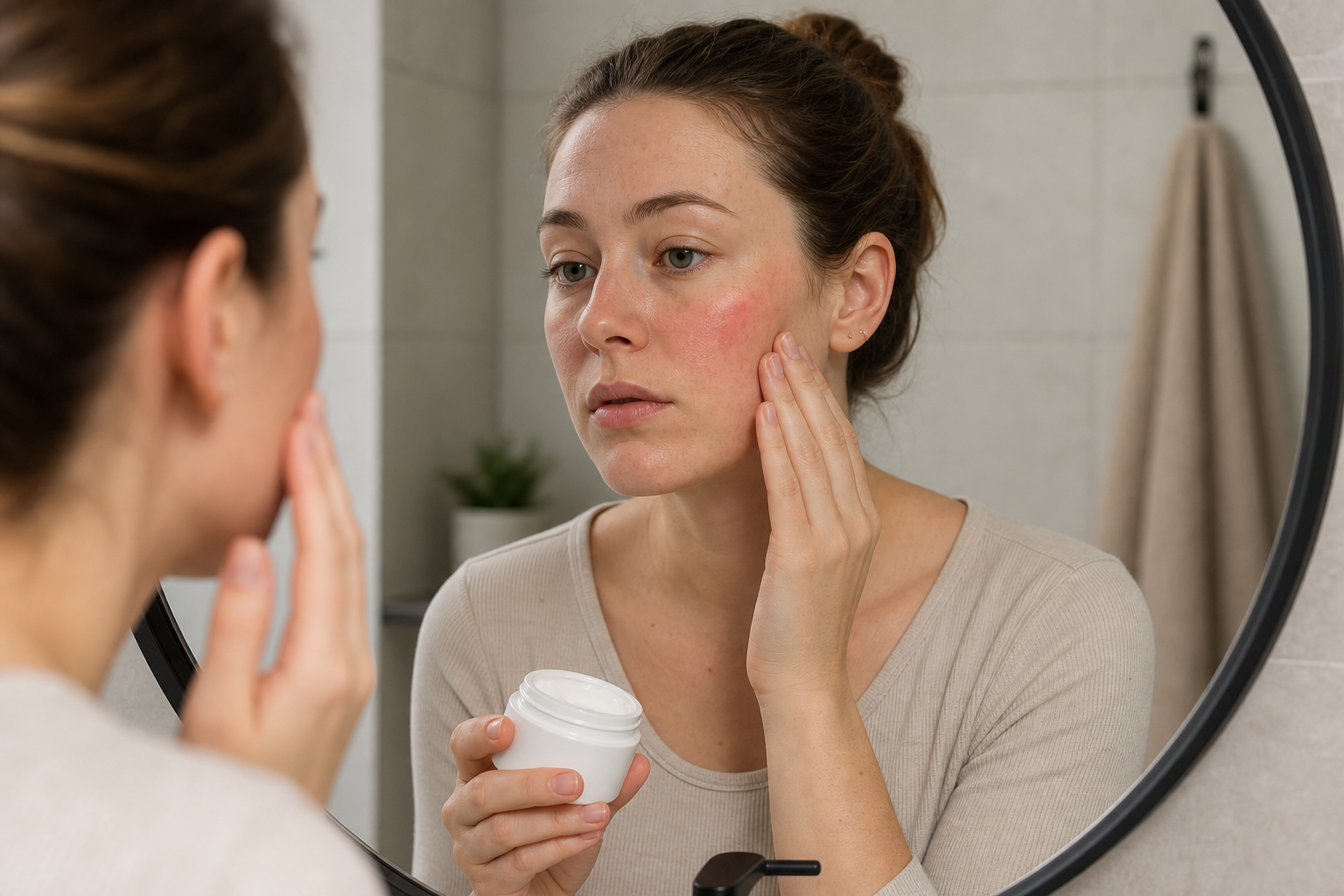
Redness itself usually comes from vasodilation, which means tiny blood vessels widen near the skin surface. That widening can happen after heat, exercise, alcohol, spicy food, emotional stress, friction, or irritating products. In sensitive skin, the threshold is lower. A cleanser that feels fine to your friend may make your cheeks pink and tight within two minutes.
There is also a nerve component. Sensitive skin often stings, burns, prickles, or feels hot even when the skin does not look dramatically inflamed. That sensation can lead people to chase more products, but adding more steps often makes the cycle worse.
A useful way to think about it:
- Trigger touches the skin or affects the body internally. 2. Barrier allows more penetration than ideal. 3. Nerve endings and immune signals react. 4. Blood vessels widen. 5. Redness, warmth, burning, bumps, dryness, or itching show up.
The important part is that redness is a signal, not a character flaw in your skin. You are not failing at skincare. Your skin is asking for fewer irritants and better recovery time.
Common Reasons Sensitive Skin Turns Red Fast
Redness is rarely random. It usually follows a pattern, although the pattern can be hard to notice when you are busy, stressed, or trying multiple products at once.
Common triggers include: – Harsh cleansers that leave skin squeaky, tight, or shiny. – Fragrance, essential oils, menthol, eucalyptus, peppermint, and citrus extracts. – Overuse of exfoliating acids, scrubs, retinoids, benzoyl peroxide, or vitamin C. – Hot water, saunas, steam rooms, intense workouts, and sudden temperature changes. – Wind, low humidity, winter heating, and high UV exposure. – Shaving, waxing, threading, depilatory creams, and repeated rubbing. – Alcohol, spicy foods, emotional stress, and flushing triggers in rosacea-prone people. – Contact allergens such as nickel, preservatives, hair dye ingredients, or certain sunscreen filters.
Cause and effect matters. If your face gets red right after cleansing, the cleanser or water temperature is a prime suspect. If redness appears 24 to 72 hours after a new product, delayed contact dermatitis may be possible. If redness clusters around the nose and cheeks with flushing, visible vessels, or acne-like bumps, rosacea is worth discussing with a dermatologist.
If the skin is itchy, scaly, cracked, or oozing, eczema or irritation may be involved.
A real-world example: someone with dry, fair, reactive skin starts a strong glycolic acid toner three nights a week because reviews say it makes skin glow. By the second week, their cheeks feel warm after every shower and sunscreen burns. The toner may not be bad, but the schedule is wrong for that skin barrier. The fix is not another active.
The fix is stopping the irritant, simplifying the routine, and rebuilding tolerance slowly.
Sensitive Skin vs Alternatives: What You Are Actually Comparing
The phrase sensitive skin vs alternatives sounds like a product comparison, but in skincare it is more useful as a skin-behavior comparison. Sensitive skin can overlap with other skin types, so the goal is not to pick a label forever. The goal is to understand what your skin does under stress.
Plain text comparison table:
Skin pattern | Typical signs | Redness tendency | Common mistake | Better first move Sensitive skin | Stinging, burning, quick flushing, tightness | High after products, friction, weather, or heat | Trying too many calming products at once | Simplify and patch test Dry skin | Flaking, roughness, dullness, tightness | Moderate to high if barrier is cracked | Using only
oils without humectants or barrier lipids
| Add glycerin, ceramides, petrolatum where needed Oily skin | Shine, enlarged-looking pores, congestion | Variable; redness may follow harsh acne routines | Stripping with foaming cleansers and alcohol toners | Use gentle cleanser and targeted acne care Acne-prone skin | Comedones, inflamed pimples, clogged pores | Often around pimples or from treatments | Layering benzoyl peroxide, acids, and retinoids too fast | Introduce one active slowly Rosacea-prone |
|---|
skin | Flushing, persistent central redness, visible vessels, bumps | High with heat, alcohol, spicy food, sun, stress | Treating it like acne only | Seek clinician guidance and reduce flushing triggers Allergy-prone skin | Itching, rash, swelling, delayed reactions | Can be high and patchy | Rechallenging the same suspect product repeatedly | Stop suspect and consider patch testing
This comparison helps reduce purchase uncertainty. If your main issue is a damaged barrier, you may not need a redness-correcting serum. If your main issue is rosacea, an over-the-counter moisturizer may help comfort but will not replace medical guidance. If your main issue is contact allergy, the prettiest sensitive-skin label on a bottle does not guarantee safety.
For a deeper routine foundation, it helps to pair this guide with a gentle baseline routine such as Gentle Skincare Routine for Sensitive Skin. Keep the baseline boring. Boring is often what reactive skin needs first.
How to Fix Sensitive Skin Without Making It Worse
The safest approach is not dramatic. It is a controlled reset. When people ask how to fix sensitive skin without making it worse, the answer is usually to stop provoking the barrier before trying to improve it.
Start with a two-week calm-down phase if your redness is mild and not medically urgent:
- Use a gentle, non-scrubbing cleanser once daily at night. Rinse with lukewarm water, not hot. 2. In the morning, splash with water or use cleanser only if you are oily or sweaty. 3. Apply a bland moisturizer with barrier-supporting ingredients such as glycerin, ceramides, panthenol, dimethicone, squalane, or petrolatum. 4. Wear broad-spectrum sunscreen every morning. Mineral sunscreens with zinc oxide can be easier for some reactive faces, though texture and cast are tradeoffs. 5. Stop exfoliating acids, scrubs, retinoids, strong vitamin C, fragranced oils, peels, and new masks during the reset. 6. Avoid hot showers on the face and reduce rubbing with towels. Press-dry instead. 7. Track triggers in a simple note: product, time, redness level, burning, itching, weather, exercise, food, and stress.
The calm-down phase is not meant to be your permanent skincare identity. It is a way to find your baseline. Once the skin is quieter, reintroduce one product at a time every 7 to 14 days. If your face burns within minutes, stop. If you get an itchy rash later, stop and consider medical advice, especially if reactions repeat.
A common mistake is treating redness as a pigment problem. Redness is often inflammation or vascular response, not uneven skin tone in the usual sense. Brightening ingredients may help some discoloration concerns, but they can aggravate sensitive skin if introduced too soon.
Another mistake is switching everything at once. When a person buys a new cleanser, toner, serum, moisturizer, sunscreen, and exfoliant in one weekend, there is no way to know which product caused the flare. Skin confidence comes from a slower process, not from a larger cart.
How to Choose Products When Your Skin Gets Red Easily
Choosing for sensitive skin is partly about ingredients, partly about format, and partly about your personal history. Tests and reviews commonly focus on texture, fragrance, finish, residue, sunscreen cast, active ingredient strength, and whether a product pills under makeup. For reactive skin, those points matter, but tolerance matters more.
Use this practical evaluation checklist before buying or applying something new: – Fragrance: choose fragrance-free over scented, especially for leave-on products. – Essential oils: be cautious with tea tree, lavender, citrus, peppermint, eucalyptus, and menthol. – Active strength: lower percentages and slower schedules usually beat aggressive formulas. – Product role: ask whether it cleanses, moisturizes, protects, or treats.
If it does none clearly, skip it. – Contact time: rinse-off products are often easier to tolerate than leave-on actives, but not always. – Patch testing: apply a small amount to the jawline or inner arm for several days before full-face use. – Packaging: pumps and tubes reduce repeated finger contact compared with open jars. – Claims: sensitive-skin marketing is not a medical guarantee.
Features that are often helpful include a non-foaming or low-foam cleanser, a moisturizer with humectants and barrier lipids, and sunscreen you will actually wear. Specs are not just for electronics. In skincare, measurable details such as SPF 30 or higher, broad-spectrum labeling, active percentages, pH-balanced formulas, and fragrance-free labeling can help you compare options.
There are tradeoffs. A richer balm may calm winter cheeks but feel heavy on acne-prone skin. A mineral sunscreen may sting less but leave a cast. A gel moisturizer may feel elegant but not protect a cracked barrier enough in low humidity. The best choice is not the most expensive one. It is the one your skin can tolerate consistently.
If you want help understanding ingredient labels, keep a reference like How to Read Skincare Ingredient Lists handy while you compare formulas.
Pros: What Sensitive-Skin Routines Do Well
A sensitive-skin routine can feel limiting at first, but there are real advantages.
First, it forces clarity. You learn which products have a job and which ones are just noise. Cleanser, moisturizer, sunscreen, and one targeted treatment can outperform a complicated routine if your previous approach kept triggering redness.
Second, it lowers risk. Fragrance-free, low-irritant routines reduce the chance of avoidable stinging and barrier damage. They also make it easier to identify true medical patterns because fewer cosmetic variables are interfering.
Third, it supports consistency. Sensitive skin often improves when the routine is predictable. That does not mean redness disappears forever, but flare-ups may become less frequent and easier to trace.
Fourth, it can save money. The question is is sensitive skin worth it often comes from shoppers wondering whether sensitive-skin products cost more for little benefit. A better way to frame it is this: a sensitive-skin approach is worth it if it prevents repeated irritation, wasted products, and panic-buying after flare-ups. You do not need every product labeled sensitive.
You need products with fewer likely triggers and a routine that respects your threshold.
Cons and Tradeoffs: What a Gentle Routine Cannot Do
Gentle skincare has limits. It can support the barrier and reduce avoidable irritation, but it cannot diagnose persistent facial redness. It also cannot cure rosacea, eczema, psoriasis, lupus rash, infection, or allergy. If your redness is worsening, painful, hot, swollen, or spreading, do not keep experimenting at home.
The biggest tradeoff is speed. Gentle routines often work slowly. People used to strong exfoliants may miss the instant smooth feeling. But that instant smoothness can come with hidden cost if the barrier is already inflamed.
Another tradeoff is acne management. If you are acne-prone, removing all actives may temporarily allow clogged pores to build. The answer is not to attack the skin; it is to reintroduce one evidence-supported acne treatment at a tolerable pace. A clinician can help balance acne control with barrier protection.
There is also the emotional tradeoff. Sensitive skin can make you feel left out of trends. Retinal, exfoliating acids, brightening serums, barrier peels, and viral masks may look tempting. Some may eventually fit your routine. But when your skin is red and burning, restraint is not boring. It is strategy.
Hair Removal and Redness: How to Use Veet Sensitive Skin Cream More Safely
Hair removal is one of the most common redness triggers because it combines chemistry, friction, and timing. If you are searching how to use Veet sensitive skin cream, read the product label first and follow the current package directions exactly, because formulas and timing instructions can vary by region and product type.
General safety principles for depilatory creams are consistent:
- Do a patch test on a small area at least 24 hours before broader use, even if you used a similar product before. 2. Apply only to skin areas listed on the product label. Do not use body depilatory cream on the face, genitals, broken skin, sunburn, irritated patches, moles, scars, or active rashes unless the label specifically allows it. 3. Do not exceed the maximum time on the instructions. More time does not mean smoother results; it means higher irritation risk. 4. Remove gently with the recommended tool or a soft damp cloth. Do not scrub. 5. Rinse thoroughly with lukewarm water and pat dry. 6. Avoid acids, retinoids, fragrance, tanning products, deodorant on treated underarms, hot baths, and heavy exercise right after use if your skin is reactive. 7. Moisturize with a bland, fragrance-free product afterward if the area feels dry.
Who should skip depilatory creams? Anyone with current irritation, eczema flare, open cuts, recent sunburn, known allergy to depilatory ingredients, or a history of chemical burns from these products should avoid them or speak with a clinician. People using prescription retinoids, exfoliating medications, or treatments that thin or irritate the skin should be especially careful.
Compared with shaving, depilatory creams can reduce razor nicks, but they may cause chemical irritation. Compared with waxing, they avoid pulling hair from the root, but results may not last as long. Compared with laser hair removal, they are cheaper upfront, but the effect is temporary and can be less predictable on sensitive skin.
Who Should Buy This Approach and Who Should Skip It
A gentle sensitive-skin approach is a good fit if your redness is mild to moderate, comes after products or environmental triggers, and improves when you simplify your routine. It is also useful if you feel overwhelmed by choices and need a safer way to compare products without buying everything.
You should consider this approach if: – Your skin often stings after cleanser, sunscreen, or moisturizer. – Your cheeks flush after heat, wind, workouts, or strong products. – You recently overused exfoliants, retinoids, or acne treatments. – You want a low-risk routine before adding targeted actives. – You are trying to identify whether a product, habit, or climate change is the problem.
Skip self-directed trial and error and book care instead if redness is severe, painful, swollen, blistering, crusting, infected-looking, around the eyes, or associated with fever. Also seek professional advice if you have persistent central facial redness, visible blood vessels, acne-like bumps that do not respond to gentle care, or repeated allergic-type reactions.
A dermatologist may recommend prescription treatments, patch testing, or a diagnosis-specific plan.
This is also where confidence improves. You do not have to decide between doing nothing and buying a full routine. You can decide whether your situation belongs in home-care territory, clinician territory, or a mix of both.
Common Mistakes That Keep Redness Coming Back
The most common mistake is using a damaged-skin routine on an already damaged barrier. For example, a person notices texture, adds an exfoliating toner, gets red, then adds a soothing serum, then a richer moisturizer, then a mask. The skin is now dealing with four new formulas and still has not had a chance to recover.
Another mistake is chasing the word natural. Poison ivy is natural. Citrus oils are natural. Fragrance compounds can be natural and still irritating. Sensitive skin usually cares less about the marketing story and more about the actual exposure.
A third mistake is assuming tingling means working. Tingling can happen with some active ingredients, but burning, hot redness, or persistent stinging is not a badge of effectiveness. It is information.
People also forget non-product triggers. Pillowcase detergent, hair products touching the cheeks, wool scarves, mask friction, hot yoga, winter wind, and over-cleansing after workouts can all matter. If redness appears along the jawline or sides of the face, look beyond face cream. Hair spray, leave-in conditioner, beard products, and laundry fragrance may be involved.
Finally, do not keep re-testing a product that repeatedly causes a reaction. One accidental flare is data. Two or three flares are a pattern.
Recommendation: A Calm, Evidence-Informed Routine for 2026
For most people with reactive redness, the best recommendation is a boring three-step core for at least two weeks: gentle cleanse, barrier-focused moisturize, and daily sunscreen. After that, add one treatment only if there is a clear goal, such as acne, texture, dark spots, or fine lines.
A practical morning routine:
- Rinse with lukewarm water or use a gentle cleanser if needed. 2. Apply a fragrance-free moisturizer while skin is slightly damp. 3. Use broad-spectrum SPF 30 or higher every day.
A practical evening routine:
- Cleanse gently, especially if you wore sunscreen or makeup. 2. Moisturize generously. 3. If the skin is calm for two weeks, consider one targeted active no more than 1 to 2 nights weekly at first.
If you reintroduce retinoids, acids, benzoyl peroxide, or vitamin C, separate them. Do not restart all of them in the same week. For retinoids, many sensitive-skin users do better with a moisturizer sandwich: moisturizer, small amount of retinoid, moisturizer again. For acids, lower frequency matters more than chasing high percentages.
For benzoyl peroxide, short-contact therapy may be less irritating for some people, but acne treatment should be individualized.
If you need a broader routine map, use Barrier Repair Skincare Routine as your next step after your skin is calm.
The main point: redness-prone skin does not need perfection. It needs fewer surprises, more recovery time, and a routine you can repeat without fear.
Frequently Asked Questions
Why does sensitive skin turn red easily after washing?
Sensitive skin often turns red after washing because cleansing removes oil, changes the skin surface temporarily, and adds friction. Hot water and foaming surfactants can make this worse. If your face feels tight or burns after washing, switch to lukewarm water, reduce morning cleansing, and use a gentle fragrance-free cleanser at night.
How can I tell if redness is sensitivity or rosacea?
Sensitivity often appears after a product, weather change, shaving, or friction and may improve with a simpler routine. Rosacea often involves repeated flushing, persistent redness across the central face, visible vessels, burning, or acne-like bumps. The two can overlap, so persistent or worsening redness deserves a dermatologist's opinion.
What ingredients should sensitive red skin avoid first?
Start by avoiding fragrance, essential oils, harsh scrubs, high-strength exfoliating acids, strong alcohol-heavy toners, menthol, and too many actives at once. Not everyone reacts to the same ingredients, so avoid making a permanent banned list too quickly. Remove the most common irritants first, then reintroduce carefully.
Can sunscreen make sensitive skin red?
Yes. Some people react to certain sunscreen filters, fragrance, preservatives, or the rubbing needed to apply sunscreen. Mineral sunscreens with zinc oxide may be better tolerated by some sensitive users, but they can feel thicker or leave a white cast. Patch test and prioritize daily wearability over trendy formulas.
Is sensitive skin worth it to treat with special products?
A sensitive-skin routine is worth it when it reduces flare-ups and helps you stop wasting money on irritating products. You do not need every item to be expensive or labeled sensitive. The better investment is a simple routine with fragrance-free basics, careful patch testing, sunscreen, and medical help when symptoms suggest more than irritation.
When should I see a dermatologist for red sensitive skin?
See a dermatologist or qualified clinician if redness is painful, hot, swollen, blistering, oozing, spreading, near the eyes, linked with fever, or not improving after a gentle routine. Also seek help for suspected rosacea, eczema, allergic reactions, scarring, medication-related reactions, or redness during pregnancy or nursing.
Final Takeaway
Sensitive skin turns red easily because its barrier, nerves, immune signals, and blood vessels react quickly to triggers. The most reliable path is not a cabinet full of calming products. It is a slower system: identify triggers, protect the barrier, choose lower-risk formulas, compare tradeoffs honestly, and get clinical help when redness stops behaving like simple irritation.