Patch Test Skincare Serum: What Matters First
To patch test skincare serum, apply a small amount of the complete formula to a limited, observable area, keep the rest of the skincare ingredients stable, and follow the product label before considering wider use. This gives you narrow information about how that serum fits the selected area under specific conditions.
It does not prove that the formula will suit every part of the face, every combination of ingredients, or every future use.
This article provides general cosmetic information limited to cosmetic ingredient selection and use. It cannot determine what will suit every person because individual responses vary; the product label and its directions take priority over general guidance.
A serum should be considered as a complete formula, not only by its highlighted ingredient. The base, solvents, preservatives, fragrance components, botanical extracts, exfoliating ingredients, retinoid-related ingredients, and acidity may all affect compatibility. Two serums featuring the same ingredient can still differ in directions, supporting ingredients, and routine fit.
Before applying the product, read its label and note the intended area, application instructions, suggested frequency, storage guidance, warnings, and any directions about combining it with other skincare ingredients. The American Academy of Dermatology’s skincare basics supports paying attention to product directions and making changes thoughtfully.
A patch test answers a limited question: does this particular serum appear acceptable on this small test area under the conditions used? It cannot identify which ingredient caused an unwanted response, predict every later response, or establish that the formula belongs in a more complicated routine. Treat the outcome as one piece of evidence rather than a guarantee.
Set a Stable Patch Test Skincare Serum Baseline First
A stable baseline makes the outcome easier to interpret. Keep familiar skincare ingredients consistent while assessing the serum, and avoid introducing a new cleanser, exfoliating formula, moisturizer, or second active product at the same time. If several variables change together, an altered test area cannot be confidently linked to one serum.
Stable does not mean removing every product from the routine. It means avoiding unnecessary changes during this limited assessment. For example, if the serum is the only unfamiliar ingredient, the observation has a clearer connection to that formula than it would if a new exfoliant and a different fragranced product were also introduced.
Choose a small area that is easy to observe and away from the eyes, lips, and other contact areas. Use the location named by the label when one is provided. If the label does not specify a location, select a discreet area that has not recently been scrubbed, exfoliated, shaved, or altered by another unfamiliar product.
The selected area is a practical limitation. It cannot reproduce every condition involved in broader use, such as a larger surface, repeated layering, friction, or contact with other formulas. A clear result on one small area is useful, but its scope remains narrow.
Before testing, inspect the complete ingredient list. Note whether the serum contains several unfamiliar components and whether any ingredient overlaps with products already used elsewhere. The featured ingredient is not necessarily the only variable. Ingredient lists and label directions provide more useful information than promotional descriptions alone.
A useful diagnostic clue is whether the planned test is actually isolated. If the area has recently been changed by another product, or if the serum will be layered with a second unfamiliar formula, the evidence is already weaker before application begins. In that situation, stabilize the conditions first rather than trying to compensate with a larger amount or a longer exposure.
The First Patch Test Skincare Serum Move Under Real Conditions
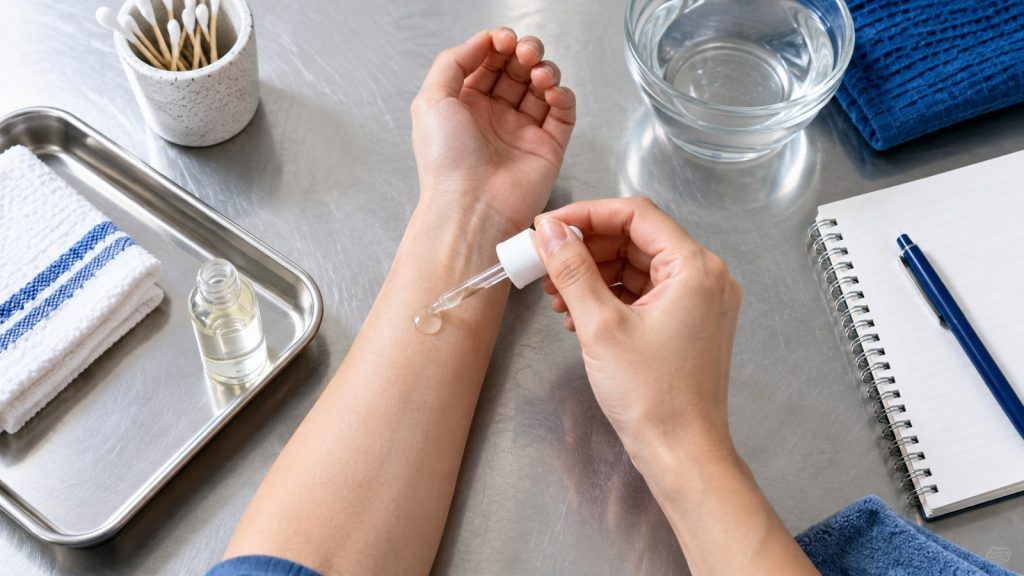
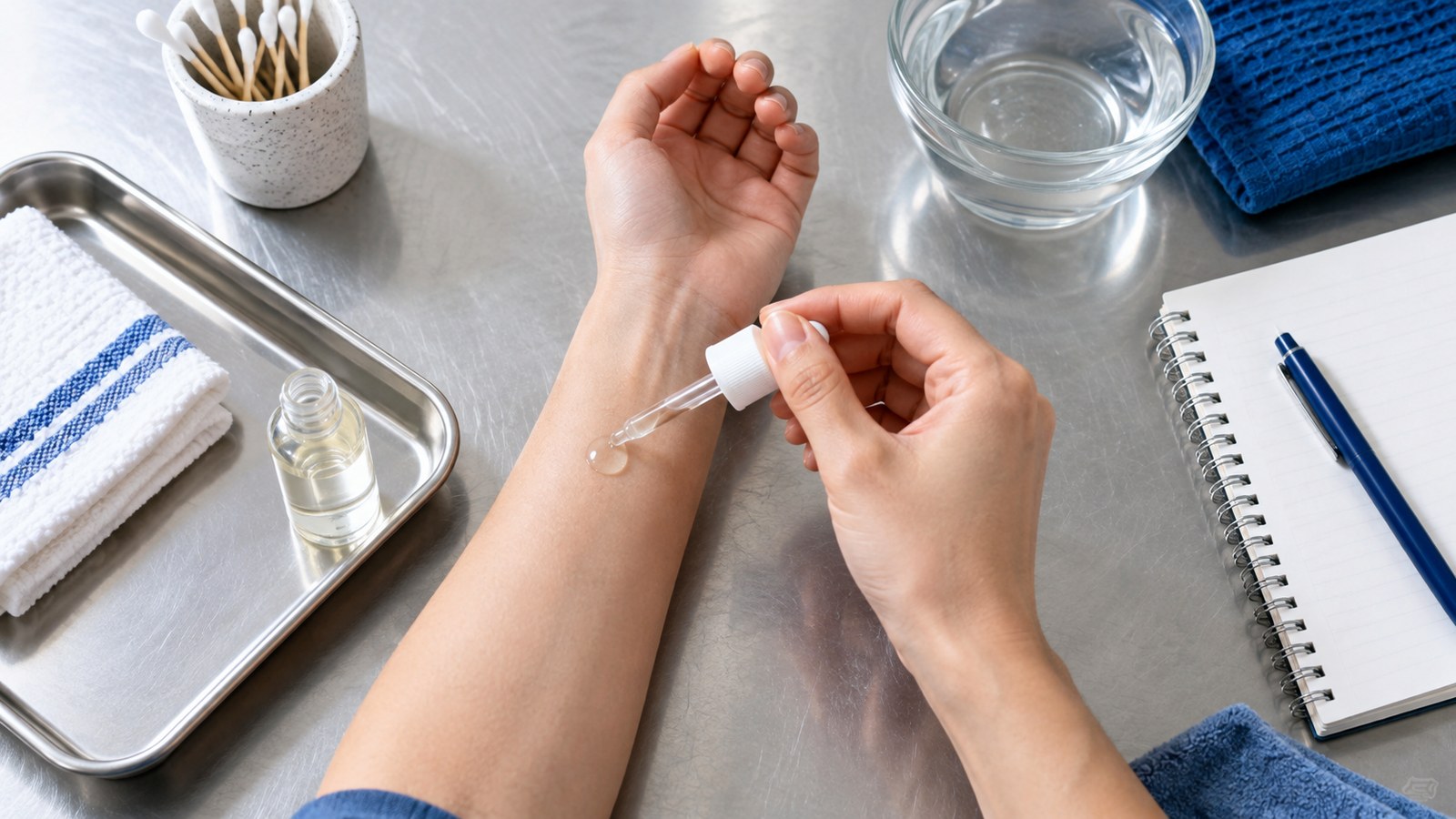
Begin by applying the serum to clean, dry skin unless the label says otherwise. Place a small amount on the selected area – enough to represent ordinary application without deliberately creating a thick layer. Do not dilute, mix, or transfer the formula, because changing it means you are no longer evaluating the serum as directed.
Keep the test area otherwise undisturbed. Do not cover it unless the product instructions specifically require that. Avoid placing another unfamiliar skincare ingredient over the same area, and do not repeatedly reapply the serum to force a clearer answer.
If you are comparing formulas or introducing more than one change over time, record the serum, location, and application date. A brief note prevents confusion about which product was used where. Test one unfamiliar serum at a time; using adjacent areas does not remove the uncertainty created by changing two formulas simultaneously.
Observe the area according to the label’s stated instructions or period. If the label provides no patch-testing directions, do not invent a strong schedule, larger amount, or special mixing method. Leave the area alone and compare it with nearby skin without repeatedly touching, scrubbing, or adding products.
Look for decision-relevant signals rather than trying to interpret every minor variation. A comfortable, unchanged area gives limited support for compatibility under those conditions. Increasing discomfort, visible alteration, or an unclear change means the evidence does not support expanding use. The test is not improved by making the exposure stronger.
If the limited test remains acceptable, introduce the serum only as the label directs. Keep the rest of the routine steady so that later observations remain interpretable. A successful patch test does not authorize using the serum more often, applying a thicker layer, or combining it immediately with another unfamiliar active formula.
Compatibility and tolerance are related but separate questions. A serum may appear acceptable on a small area while still being an awkward fit beside another product because the labels discourage combining them or because the routine contains too many simultaneous active ingredients. How to Use Active Ingredients Skincare offers additional context for evaluating ingredient combinations.
How to Scale Back a Patch Test Skincare Serum Fix
The most common setback is expanding use too quickly after a limited test. A small-area application involves less surface and less layering than broader use. If the wider application becomes difficult to interpret, do not respond by applying more serum or adding another product to counterbalance the change.
Instead, stop introducing new variables, return to the previously stable ingredient set, and review the label again. A smaller corrective action is to leave the uncertain combination alone until the conditions are easier to interpret. Repeating the same unclear test without changing the conditions does not create better evidence.
Another failure mode is testing an area that has recently been altered by vigorous cleansing, exfoliation, shaving, or another unfamiliar formula. That area is not a stable comparison. The appropriate response is to postpone interpretation rather than treating the outcome as a definitive judgment about the serum.
Avoid several changes that obscure the outcome:
- Do not scrub the test area to remove the product more aggressively than the label directs.
- Do not apply a heavy layer to obtain a stronger signal.
- Do not dilute the serum or mix it with another product unless the label specifically directs that method.
- Do not add a second new ingredient to make the area feel or look different.
- Do not automatically blame the highlighted ingredient when the complete formula contains several plausible variables.
If the test area becomes increasingly uncomfortable or visibly altered, stop using the serum on that area and do not expand application while the outcome is unclear. If the problem worsens after stopping, seek qualified help rather than repeatedly testing the formula. This is a boundary for the information available here, not a diagnosis of what caused the change.
Testing two new serums together creates a separate interpretation problem. If the area changes, the observation may relate to either formula, their shared ingredients, or their combination. The smaller replacement action is to stop treating the pair as one test, review each label independently, and avoid assigning responsibility to either serum without clearer evidence.
Routine fit also involves practical tradeoffs. A serum may contain an appealing ingredient but be difficult to place beside other active ingredients already used. If using it requires repeated improvisation, ignoring label directions, or adding several products at once, it may not be a practical fit even when one small-area application appeared acceptable.
When the Patch Test Skincare Serum Evidence Runs Out
The evidence runs out when the outcome is unclear, changes after other products are added, or cannot be separated from a recent routine change. It also runs out when the test area does not represent the intended application area or when the label’s directions conflict with the way the test was performed.
At that point, return to the official label, packaging, and manufacturer-provided directions. The U.S. Food and Drug Administration’s cosmetics guidance provides general context about cosmetic labeling and ingredient information. Use that source for labeling context, not as proof that a particular serum will suit an individual.
A limited-area test cannot establish every ingredient interaction, determine the cause of an unwanted response, or evaluate whether a cosmetic result will be suitable for a person. It contributes narrow information about apparent compatibility under the conditions used.
Do not broaden use when the test produces an unwanted response, remains ambiguous, or requires you to disregard the label. Stop adding variables and seek qualified help if the problem worsens. Repeating an unclear test is not a substitute for resolving the uncertainty.
The clearest decision path is to apply the complete formula as directed, change one unfamiliar ingredient at a time, observe without manipulating the area, and expand use only when the outcome is clear and consistent with the label. For additional ingredient context, What Skincare Ingredients Do You Actually explains why a featured ingredient should be considered alongside the complete formula.
Questions About Testing a Skincare Serum Before Wider Use
Where should I patch test a skincare serum?
Use the location named on the product label. If none is provided, choose a small, discreet area that is easy to observe and away from the eyes and lips. Avoid skin recently altered by exfoliation, vigorous cleansing, shaving, or another unfamiliar formula. A result from one location is limited evidence and does not prove compatibility everywhere.
How much serum should I use for the patch test?
Use a small amount that reasonably represents normal application to the selected area. A thick layer changes the exposure, while a barely detectable trace may not represent intended use. Do not dilute or mix the serum unless the label directs that method. The aim is to evaluate the complete formula under its stated conditions, not to create a stronger or weaker substitute.
Can I patch test two new serums at the same time?
It is better to assess one unfamiliar serum at a time. Testing two formulas together makes attribution difficult if the area changes, particularly when the products share active, fragranced, or botanical ingredients. Separate testing keeps the baseline clearer. If both have already been applied, treat the outcome as inconclusive rather than assigning responsibility to one serum.
Does a successful patch test mean I can use the serum every day?
No. A successful limited-area test does not replace the serum’s stated frequency or authorize thicker application. Follow the label, especially when the formula contains active ingredients or pairing cautions. The test provides limited information about the selected area under the conditions used; it does not establish that daily use or broader layering is appropriate.
What if the serum contains an ingredient I already use elsewhere?
Compare the complete ingredient lists and the directions for both formulas. The same named ingredient may appear in different bases, while other ingredients can affect routine compatibility. Avoid adding both products at once when the outcome would be difficult to interpret. If the labels do not explain how the formulas fit together, do not invent a stronger schedule or mixing method.
Back to top