What to Do First After Korean Skincare Irritation
When Korean skincare troubleshooting goes wrong, identify the newest change, return to the last stable setup, and pause anything that turns inconvenience into burning, swelling, pain, or a spreading rash. A complicated routine does not need a complicated rescue. The immediate goal is to separate a cosmetic annoyance, such as pilling, from a possible skin reaction that may worsen with continued exposure.
Do not scrub. Do not add another toner, mask, exfoliant, or spot treatment to counteract the problem. If a product is still on your face and the skin is burning, gently rinse it away with lukewarm water. Avoid hot water, cleansing brushes, washcloth friction, and repeated cleansing. If the affected area is around the eyes, rinse carefully and seek prompt medical guidance for eye pain or vision changes.
If you have burning, swelling, a rash, eye pain, vision changes, or symptoms that keep coming back, talk with a dermatologist, doctor, or qualified clinician.
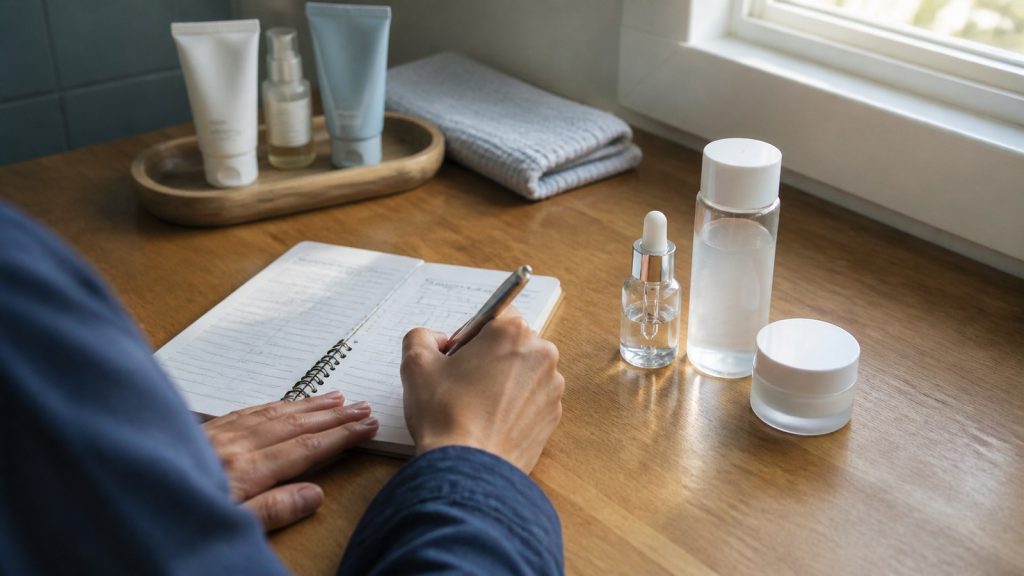
Once immediate discomfort is addressed, write down what changed. Include new products, increased frequency, a longer application time, a new layering order, and products recently restarted after a break. A familiar item can still become relevant if it was used more often or combined with another active treatment.
The most useful skincare troubleshooting usually begins with subtraction rather than a purchase. A plain cleanser and an already tolerated moisturizer may be enough while the reaction settles. Sunscreen remains relevant when it can be applied without stinging, but a formula that burns compromised skin should not be forced. Shade, a hat, and limited direct exposure can provide temporary support while you seek an option your skin tolerates.
This conservative approach aligns with the American Academy of Dermatology's skin-care guidance, which emphasizes gentle care and avoiding irritation. It cannot identify an allergy, infection, eczema flare, or other medical condition from appearance alone. That uncertainty is why escalating pain, swelling, blistering, or widespread redness belongs with a clinician rather than a longer home experiment.
Match Korean Skincare Symptoms to Likely Triggers
A Korean beauty label does not determine how skin will react. The useful clues are the symptom, its location, when it appeared, and what was applied there. Manufacturing quality and cosmetic regulation matter, but products from any country can cause irritation, allergic contact dermatitis, acne-like breakouts, or simple incompatibility with another layer.
The FDA's cosmetics information explains that cosmetic products generally do not receive premarket approval, apart from color additives, and consumers should report serious adverse events.
Use the following symptom patterns as leads, not diagnoses:
- Treat immediate burning, heat, or bright redness as possible irritation when it begins during application or soon afterward, and remove the suspected product rather than testing another layer that day. Fragrance, exfoliating products, acne treatments, retinoids, and even an otherwise bland formula can sting skin that is already disrupted.
- Review surface pilling as a layering problem when soft flakes roll off without heat, swelling, persistent redness, or skin tenderness, and change only application amount or spacing rather than replacing the whole routine. Too much product, rubbing after layers begin to set, or placing a silicone-rich layer over a tacky film can create residue that looks like peeling skin.
- Treat tightness with patchy flaking as a sign to reduce cleansing and active-treatment frequency when it appears across exposed areas, and do not use exfoliation to remove flakes while the skin remains sore. Flaking caused by irritation can look like dead skin that needs polishing, but friction may deepen the problem.
- Track small bumps by location when they repeatedly appear where a heavy or occlusive layer is applied, and avoid assuming every bump means an ingredient is universally pore-clogging. Hair products, masks, pillow contact, sweat, and preexisting acne can create a similar pattern.
- Take itching, swelling, hives, or a rash extending beyond the application area seriously when it develops after exposure, and stop the suspected product while arranging medical advice. Delayed allergic reactions may not appear during the first application and cannot be confirmed from a photograph or symptom list alone.
- Separate a possible acne-treatment adjustment from irritation when breakouts occur only in acne-prone areas after starting a treatment that changes cell turnover, but stop treating it as expected if burning, diffuse redness, swelling, or eczema-like patches appear. There is no reliable visual shortcut that proves a breakout is purging.
Timing narrows the possibilities without settling them. A sting that begins within minutes points in a different direction than bumps that develop several days later. A reaction limited to the eyelids may reflect transfer from fingers or hair rather than a product intentionally placed there. Pilling that appears only beneath makeup or sunscreen is more consistent with film incompatibility than with inflammation.
Photographs taken in consistent lighting can help document whether redness is spreading or improving. Keep the product packaging and ingredient list if professional care becomes necessary. The National Library of Medicine provides access to research on irritant and allergic contact dermatitis, but published ingredient data cannot determine an individual reaction without clinical context.
Pause K-Beauty Products, Then Reintroduce One Slowly
A stripped-back routine is an isolation method, not a punishment and not a permanent prescription. Keep only products that were tolerated before the flare and that do not sting now. If even those products burn, use as little as necessary and seek medical advice rather than repeatedly challenging inflamed skin.
Follow a controlled sequence:
- Pause recently introduced products while burning, redness, heat, or itching is active, and do not restart them merely because the symptoms look slightly better the next morning. Skin can appear calmer before tolerance has returned.
- Keep cleansing gentle when sunscreen, makeup, or visible soil needs removal, and limit washing to what is necessary rather than chasing a squeaky or oil-free finish. Lukewarm water and fingertips create less friction than brushes or textured cloths.
- Apply an already tolerated moisturizer when it does not sting, and use a modest layer rather than stacking multiple essences, emulsions, sleeping packs, and oils during the flare. More layers create more variables without proving which one helps.
- Wait until the skin has returned to its usual comfort and appearance before reconsidering paused items, and extend that recovery period or contact a clinician if symptoms recur without re-exposure. Persistent inflammation may not be a routine problem that can be solved at home.
- Patch-test a questionable cosmetic on a small, discreet area when the skin is calm, and stop the trial at the first sign of itching, swelling, burning, or a rash. A home patch test can reveal an obvious problem, but it cannot rule out a delayed allergy or guarantee facial tolerance.
- Restart a single nonessential item at its lowest reasonable frequency when the baseline remains comfortable, and leave the remaining paused products unchanged long enough to notice a recurring pattern. If several items return together, the source becomes difficult to identify.
Do not feel obligated to rebuild every step. A seven- or ten-step routine is a format, not a skin requirement. If cleanser, moisturizer, and tolerated sun protection meet your current needs, adding an essence or ampoule is optional. A routine should earn complexity through tolerance and a clear purpose.
This is also where spending money is often unnecessary. Before replacing a moisturizer, try using less of the existing formula if the only problem is pilling and the skin is otherwise comfortable. Allow each layer to settle, press rather than rub, and test whether the routine behaves differently without the most film-forming optional step.
If the skin itself is flaking, however, treating the flakes as product residue could delay recognition of irritation.
Replacing something may make sense when a formula repeatedly causes symptoms, is expired, has changed color or smell, has contaminated packaging, or cannot be used according to its label. Paying more does not guarantee greater tolerance. A shorter ingredient list does not guarantee it either.
The relevant comparison is whether the product has a necessary role, can be used consistently without discomfort, and remains compatible with the rest of the routine.
Stop Adding Actives to Irritated K-Beauty Routines
The most damaging troubleshooting error is trying to correct irritation with more treatment. Someone sees clogged pores after adding a rich cream, applies an exfoliating toner, adds a 2% salicylic acid product on alternate nights, and keeps a retinoid in rotation because stopping feels like losing progress. Each step sounds defensible by itself. Together, the routine may exceed the skin's current tolerance.
A cautionary failure pattern can unfold by day 10: acids have been stacked with other active treatments, burning redness is mistaken for purging, and use continues until the skin barrier feels as though it has collapsed. Water stings. Moisturizer stings. Patchy flakes appear around the mouth and nose. At that point, the routine has to be stripped back, not optimized with another calming serum.
That scenario is illustrative rather than diagnostic, but the cause-and-effect lesson is concrete. Purging is not a free pass for pain. Diffuse redness, sustained burning, swelling, raw patches, and worsening sensitivity are reasons to pause the suspected treatments. The American Academy of Dermatology's acne resource also cautions that irritating the skin can worsen acne, while improvement from acne treatment generally takes time.
Several failed corrections deserve particular caution:
- Avoid exfoliating visible flakes when the underlying skin feels hot, tight, or tender, and wait until comfort has returned before considering whether exfoliation still has a role. Removing the surface scale does not repair the cause.
- Avoid using multiple acne treatments on the same irritated area when the combination was not directed by a clinician, and consult the labels because over-the-counter drugs carry active-ingredient warnings and use limits. The FDA's OTC medicine guidance explains why Drug Facts labels matter.
- Avoid masking redness with fragranced packs or repeated sheet masks when the skin is reactive, and discontinue any mask that increases heat, itching, or discomfort during wear. Occlusion may intensify exposure to a troublesome formula.
- Avoid treating every post-product bump as a detoxification phase when the eruption is itchy, widespread, or appearing in unusual areas, and arrange clinical evaluation if it persists. Acne, folliculitis, dermatitis, and allergic reactions can resemble one another.
Actives are not inherently bad, and a minimalist routine is not automatically superior. The relevant tradeoff is treatment benefit versus tolerance. A medically appropriate acne treatment may be worth gradual, label-directed use, while an optional exfoliating step may offer little value if it repeatedly destabilizes the routine.
When uncertainty involves an over-the-counter drug, follow its label and ask a pharmacist, dermatologist, or doctor before combining it with another treatment.
Seek Dermatology Care for Persistent K-Beauty Reactions
Home troubleshooting has a firm boundary. Seek urgent medical help for trouble breathing, facial or throat swelling, faintness, a rapidly spreading severe rash, or other signs of a serious allergic reaction. Get prompt care for eye exposure with ongoing pain, vision changes, blistering, open sores, significant swelling, drainage, fever, or severe pain.
A dermatologist or other qualified clinician is also appropriate when redness, itching, burning, or breakouts keep returning despite product withdrawal; when a rash spreads beyond the application site; or when it is unclear whether the problem is acne, rosacea, eczema, folliculitis, infection, or contact dermatitis. Professional patch testing may be needed for suspected allergic contact dermatitis.
That is different from applying a cosmetic to a small area at home.
While waiting for care, avoid restarting the suspected trigger to obtain proof. Do not apply prescription medication belonging to someone else, and do not use an over-the-counter steroid on the face or around the eyes without guidance from a qualified professional. Bring product names, ingredient lists, photographs, symptom dates, and a list of everything applied to the affected area.
My face started burning after I used an exfoliating toner and retinoid together. It looks calmer today, so can I continue one tonight?
A calmer appearance can be misleading because irritation may return quickly after re-exposure. Do not continue either active while burning, heat, tenderness, or unusual redness remains. Keep the routine bland and previously tolerated. If ordinary moisturizer or water now stings, or if redness is spreading, contact a clinician.
Once the skin is fully comfortable, a dermatologist or pharmacist can help determine whether either treatment is appropriate and how frequently it should be used.
I added a Korean sunscreen four days ago, and now makeup rolls into flakes. There is no redness, but I cannot tell whether my skin is peeling.
Pilling advice can fail if true skin flaking is mistaken for product residue. Gently inspect the bare face before applying anything: irritated scale tends to remain attached to the skin, while pilling usually appears as movable rolls after products are layered or rubbed. If the bare skin is comfortable and smooth, try less product underneath, allow layers to settle, and avoid rubbing once films begin to form.
Do not reduce the labeled sunscreen amount merely to prevent pilling; instead, simplify the products beneath it or use makeup differently.
I stopped several new products, but the itchy bumps are still appearing a week later. Should I restart them one at a time to identify the cause?
Reintroduction may be unsafe when an itchy eruption persists without additional exposure. Delayed allergic reactions, dermatitis, acne-like eruptions, and unrelated skin conditions can follow different timelines, so a home trial may not provide a clear answer. Keep the suspected products paused, preserve their packaging, photograph the pattern, and arrange medical evaluation. Seek faster care if swelling, blistering, pain, drainage, eye symptoms, or rapid spread develops.
A failed routine does not need to be rescued in its original form. Once the skin is stable and serious causes have been excluded, only restore steps that have a defined purpose and a tolerable place in the routine. If the same discomfort returns after a particular product or combination, that recurrence is more useful than popularity, price, packaging, or the number of positive reviews.
Back to top