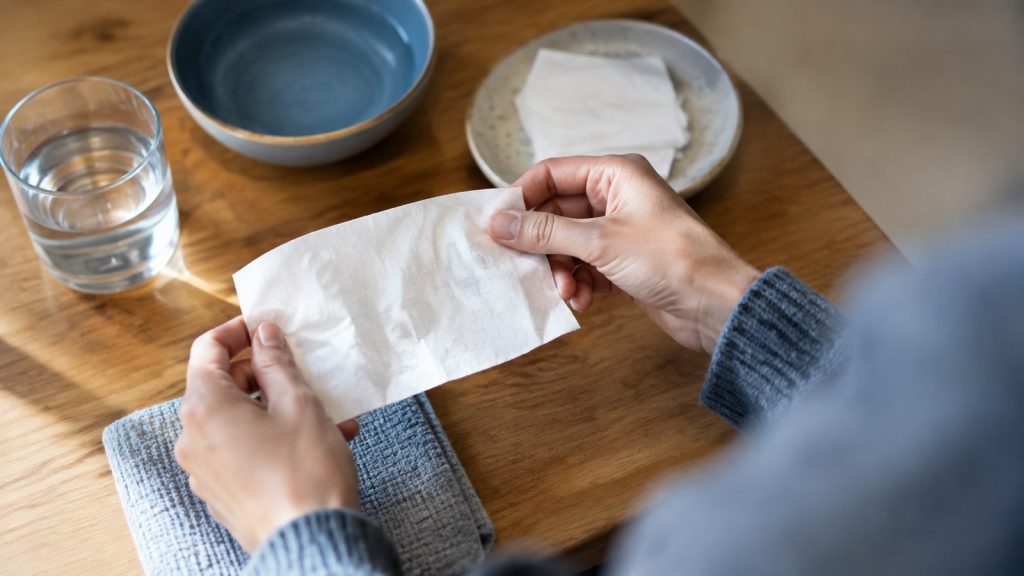
Answer: identify skin type by midday shine
A workable how can I identify my skin type starts with a simple baseline, one change at a time, and a clear way to judge whether that change helped. For skin type, that baseline is not how your face feels five minutes after washing, and it is not how shiny it looks under bathroom lighting.
The clearest everyday clue is what your skin does by midday after a normal morning: where it gets shiny, where it stays matte, where it feels tight, and whether the cheeks behave differently from the forehead, nose, and chin.
The usual skin-type labels describe repeated behavior. Oily skin tends to develop visible shine across much of the face, often with a slick feel. Dry skin tends to stay low-shine and may feel tight, rough, or flaky. Combination skin usually shows oilier behavior through the T-zone while the cheeks feel normal, dry, or more easily unsettled.
Balanced skin, sometimes called normal skin, tends to stay comfortable with only mild shine and little tightness.
That answer has limits. A single day can be misleading if your skin is reacting to overwashing, heavy weather changes, a very rich product, strong exfoliation, long sun exposure, or a stressful week. Skin type is your baseline tendency; skin condition is the temporary state sitting on top of it. The two can look similar.
For example, skin that feels tight after harsh cleansing is not automatically dry by type, and a shiny forehead after a heavy moisturizer does not prove oily skin.
A better reading comes from watching the same clues under simple, repeatable conditions. Keep the morning ordinary, avoid adding a new product that day, and read your face several hours later. Ask four plain questions: Is shine spread across the face or centered in the T-zone? Are the cheeks comfortable, tight, or rough? Does the skin feel oily, dry, or balanced before any afternoon touch-up?
Does the pattern repeat on several ordinary days? The repeated pattern is more useful than one dramatic moment.
Midday shine reveals your skin type
Midday shine matters because it appears after your skin has had time to return to its own rhythm. Right after washing, almost any face can feel tighter than usual. Right after applying a rich product, almost any face can look glossy. By midday, those early distortions usually soften, and the location of shine becomes easier to read.
If shine shows across the forehead, nose, chin, and cheeks, and the skin feels slick rather than merely dewy, the baseline may lean oily. This does not mean every area produces the same amount of oil, but the overall pattern is widespread.
Oily skin is often misread as simply "dirty" because shine is so visible, yet the clue is not dirt; it is repeated oiliness returning even when the face was cleaned normally.
If shine appears mainly on the forehead, nose, and chin while the cheeks stay comfortable, dull, tight, or slightly rough, the baseline often leans combination. This pattern rules out a simple all-over oily label because the cheeks are telling a different story. Combination skin is easy to overcorrect because the T-zone asks for less heaviness while the cheeks may need a gentler interpretation.
If very little shine appears by midday and the skin feels tight, papery, rough, or flaky, the baseline may lean dry. The key clue is not the absence of glow alone; it is low shine paired with discomfort or texture that does not feel smooth.
Dry skin can still have pores, occasional congestion, or a shiny product film, so the label should come from repeated comfort and oil patterns rather than one isolated feature.
If the face develops only light shine in predictable places and stays comfortable, the baseline may be balanced. Balanced skin is not flawless skin. It can still look dull on a tired day, feel tight after a harsh wash, or react to a poor product match. The difference is that, under ordinary conditions, it returns to comfort without strong oiliness or persistent dryness.
Pay special attention to the cheeks. They often reveal the mistake. Shiny nose plus tight cheeks points toward combination behavior, not a single all-over type. Matte cheeks plus comfortable skin is different from matte cheeks plus tightness. Location, feel, and repetition work together.
Overwashing can hide your true skin type
Overwashing can make skin type harder to read because it changes the surface before you observe it. When the face is washed too often, scrubbed aggressively, or rinsed with water that feels very hot, the skin may feel squeaky-clean at first. That feeling can be mistaken for a useful reset, but it can also create a tight, stripped sensation that has little to do with your true baseline.
The cause-and-effect chain is simple. A harsh wash can remove more surface oil than needed. The skin then feels tight, dry, or shiny in a strained way. Later, oil may return unevenly, especially through the T-zone. By the time midday arrives, the face may look both tight and shiny, which sends a confusing signal.
That mixed result can lead someone to call the skin oily, dry, and sensitive all at once, when the first problem was that the starting point was too disrupted.
This matters because skin type reading depends on calm conditions. If every morning begins with a strong cleanse, a rough cloth, and repeated rinsing, the face you read at noon is not a clean baseline; it is a rebound pattern. The same issue can happen if several new products are added during the same week. Too many changes turn the skin into a moving target.
Real life still has constraints. Sweat, sunscreen, makeup, and pollution may make evening cleansing necessary. The goal is not to avoid cleansing; the goal is to avoid making the reading harsher than the day requires. A face that was washed normally in the morning and then observed without extra interference tells you more than a face that was repeatedly scrubbed because the first shine felt annoying.
To avoid masking the pattern, keep the wash simple on observation days. Use the same gentle approach you can repeat, keep the water comfortably lukewarm, and stop once the face feels clean rather than squeaky. Then leave enough time for the skin to show its own behavior. If the label changes every time the washing style changes, the wash is part of the signal, not just the background.
Try the bare-face skin type test
A bare-face reading is useful because it reduces the biggest sources of confusion: product shine, heavy residue, and immediate post-wash tightness. It does not need special tools. It needs ordinary conditions and restraint. The point is to watch how the skin behaves when fewer variables are covering it.
Use this process on a normal day, not on a day when your skin is already unusually irritated, heavily sun-exposed, or recovering from a product that clearly did not suit you.
- Wash your face with your usual mild cleanser when your skin is not already irritated, and limit the wash to one normal pass so the surface is not stripped before you read it.
- Pat your skin dry with a clean towel when the face is no longer dripping, and avoid rubbing so redness or tightness from friction does not become part of the reading.
- Leave your face bare for about an hour if your skin feels comfortable enough, and skip leave-on products during that short window so product finish does not mimic oil or dryness.
- Notice your cheeks, forehead, nose, and chin in natural light when the waiting period ends, and limit the judgment to shine, tightness, roughness, and comfort rather than pore size alone.
- Recheck the same zones around midday if your day is ordinary, and avoid changing the label from a single reading if the pattern does not repeat.
The first hour shows how the skin settles after cleansing. Midday shows how it behaves after time has passed. Together, those two moments are more useful than either one alone. If the skin feels tight right after washing but becomes comfortable later, the tightness may come from the wash.
If it feels comfortable after washing but becomes shiny across the whole face by midday, the baseline may lean oily. If the T-zone shines while the cheeks feel tight, combination behavior is more likely.
Keep the rest of the day as unchanged as possible. Do not add a new exfoliating step, swap several products, or judge the outcome after an unusually sweaty workout. The test works best when the only meaningful change is the temporary bare-face window. Everything else should stay close to your normal routine so the outcome reflects your skin, not an experiment that is too artificial to repeat.
When your skin type keeps changing
Skin can seem to change type when the baseline is mixed with temporary surface behavior. Weather, indoor heating, humidity, travel, sleep changes, frequent washing, and product residue can all shift how the face looks and feels. That does not always mean the underlying type has changed. It may mean the current state is louder than the baseline.
Where I Stopped Forcing It is this: if every observation gives a different answer, stop changing multiple variables at once. Keep the wash style steady, avoid adding new leave-on products for the purpose of reading your type, and watch the same zones at the same points in the day.
If the cheeks are tight one day, shiny the next, and rough after a different wash, the pattern is not ready for a permanent label.
A useful next decision is to choose the most consistent baseline label, then add a temporary note. For example, "combination with tight cheeks in winter" is more helpful than switching between oily and dry every few days. "Balanced but easily thrown off by overwashing" is more useful than assuming the skin has no pattern. These phrases keep the label flexible without making it meaningless.
The questions I wish I had asked sooner
Can my skin be oily and dry at the same time?
Yes, the face can show oily and dry-looking behavior in different areas or at different moments. Read the locations separately when the T-zone shines but the cheeks feel tight, and limit the label to combination until the pattern repeats under ordinary conditions.
Should I call my skin sensitive if it reacts often?
Sensitivity is better understood as a reaction tendency, not a classic oil-and-dryness type. Track what your skin reacts to when the reaction is mild and temporary, and avoid replacing your oil-level label with "sensitive" unless you also note whether the baseline is oily, dry, combination, or balanced.
What if my skin feels tight but looks shiny?
Read that as a mixed signal instead of forcing one label. Review your cleansing style when tightness appears soon after washing, and limit conclusions until you have seen whether the shine returns across the whole face or mainly through the T-zone.
How many ordinary days should I watch before deciding?
Use several ordinary days rather than one perfect or chaotic day. Compare the same zones under similar conditions, and limit the final label to the pattern that appears most often. If no pattern holds, keep the label broad, such as combination or currently unsettled, until the baseline becomes easier to see.
The most useful answer is not the most dramatic one. Identify the repeated midday pattern, separate skin type from temporary surface behavior, and stop the process when extra changes are making the reading less clear.
Back to top