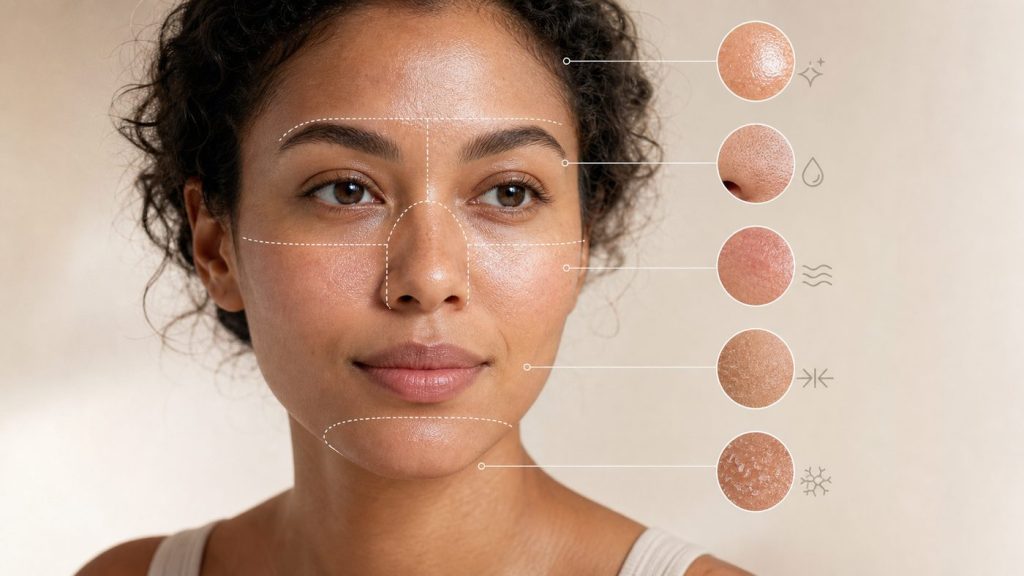
A reliable skin type basics test looks for a repeated pattern of oiliness, tightness, comfort, and flaking across different facial zones. It does not classify your skin from one photograph, one breakout, or the temporary tightness that follows harsh cleansing.
The aim is to identify a useful baseline – oily, dry, combination, or balanced – while treating dehydration, sensitivity, irritation, and possible skin conditions as separate concerns. Any skin type can become dehydrated or irritated, and those temporary changes can conceal the underlying pattern.
Health note: This guide provides general education, not medical diagnosis or treatment. Burning, swelling, a spreading rash, eye symptoms, breathing difficulty, or persistent unexplained changes require advice from a dermatologist, doctor, or other qualified clinician.
Start With the Clearest Signal
Identify when skin type basics test goes wrong, return to the last stable setup, and pause any change that turns inconvenience into damage or pain. Outside help is safer if burning, swelling, spreading redness, or unusual breakouts keep worsening after the newest change is removed.
Why Skin Type and Skin Condition Get Confused
Skin type describes a broad baseline tendency, particularly the distribution of oil and dryness. Skin condition describes what changed now. The two can overlap without being the same.
Naturally oily skin, for example, can become dehydrated after repeated washing or use of irritating treatments. It may look glossy while feeling tight or rough underneath. Dry skin may appear shiny after a rich product leaves a surface film. Combination skin may develop flaky cheeks during cold weather while the central face continues producing visible oil.
Timing and location make those situations easier to separate:
- Oil present before the morning cleanse may reflect overnight production, although residue from a heavy nighttime layer can exaggerate it.
- Shine that returns near midday is more informative on a typical indoor day than after exercise, heat exposure, or a humid commute.
- Flaking confined to one recently irritated patch should not determine the classification of the entire face.
- A recurring contrast between the T-zone and outer cheeks is stronger evidence for combination skin than one isolated oily or dry day.
Dehydration refers to a temporary shortage of water in the outer skin layers; it is not a genetic skin type. Dehydrated skin can still produce oil. This is why the combination of surface shine and underlying tightness should prompt a review of cleansing, weather exposure, and active treatments before you conclude that more oil removal is needed.
Sensitivity also belongs in a separate category. Oily, dry, combination, and balanced skin can all sting or react. Frequent burning, itching, or redness may indicate irritation, an allergy, or another condition rather than dryness alone.
The [American Academy of Dermatology explains that contact dermatitis can cause itching, swelling, tenderness, burning, and cracked or scaly skin](https://www.aad.org/public/diseases/eczema/contact-dermatitis), supporting the need to treat persistent reactions as more than a skin-type question.
Misreading these signals can create a cycle. Someone sees oil, washes more aggressively, feels tight, applies a thick layer everywhere, and then washes again when the face feels coated. Each correction changes the surface and makes the original tendency harder to recognize.
Read the Face by Zone and Time
Assess the forehead, nose, inner cheeks, outer cheeks, and chin separately. Use descriptive notes before choosing a label. "Nose glossy by noon and outer cheeks comfortable" is more useful than immediately writing "oily skin."
An oily pattern is more likely when most zones repeatedly become greasy or visibly shiny under ordinary conditions. Oil generally returns after gentle cleansing without the entire face first becoming painfully tight, itchy, or inflamed.
A dry pattern is more likely when most zones stay tight, rough, or flaky even after you remove obvious sources of irritation. Perspiration and occasional surface shine do not rule out dry skin, especially when the shine appears only after sunscreen, moisturizer, heat, or physical activity.
A combination pattern is more likely when the forehead and nose repeatedly become oily but the outer cheeks require a different application amount to remain comfortable. The contrast should recur often enough that treating the entire face identically creates either coated central areas or under-supported cheeks.
A balanced pattern is more likely when the face generally remains comfortable and no zone shows persistent excess oil, scaling, or tightness. Balanced skin can still react to unsuitable products, weather changes, hormonal shifts, illness, or excessive cleansing.
Pores and breakouts are supporting observations, not deciding evidence. Pores may appear more noticeable because of genetics, age, lighting, camera sharpening, or surface buildup. Acne can occur with any skin type and may also be influenced by hormones, medication, friction, cosmetics, and inflammatory skin conditions.
Interpret sudden changes cautiously. Climate, age, medication, hormonal changes, health conditions, and prescribed treatments may alter oiliness or dryness. If your established pattern changes abruptly and remains different without an obvious explanation, a clinical assessment is more useful than repeatedly taking a skin type analysis test.
Observe Three Ordinary Days Without Provoking Irritation
Choose days that resemble your usual routine. Postpone the observation if your face is sunburned, actively inflamed, cracked, recovering from a strong treatment, or reacting to something new. Do not stop prescribed medication or necessary sun protection to make the assessment appear more controlled.
- Choose three ordinary days within a similar weather period, and exclude any day dominated by illness, strenuous outdoor activity, air travel, or unusual heat. Mark an unexpected event in your notes rather than treating it as evidence of your baseline.
- Pat the face dry with a clean, soft towel, then observe it for no longer than 30 minutes before applying comfort care. End the interval immediately if meaningful burning, itching, or painful tightness develops.
- Inspect the forehead, nose, inner cheeks, outer cheeks, and chin in the same indoor lighting, recording shine, flakes, redness, and physical comfort for every zone. Use concrete descriptions such as "outer cheeks rough" instead of assigning a skin-type label at this stage.
- Spread a thin layer of your familiar moisturizer over areas that begin to feel tight, adding a second small amount only where comfort does not return. Keep the application lighter on zones where the same quantity usually leaves a lasting greasy film.
- Apply your usual tolerated sunscreen in its normal amount, then note whether it creates uniform shine, localized pilling, or a coated feeling. Keep sun protection in place; account for its finish when reviewing the later observation rather than removing it for the test.
- Recheck the same five zones near midday before washing, blotting, or exercising, then repeat the sequence on the other selected days. Classify only a pattern that appears on at least two representative days; if all three differ, wait for more stable conditions instead of choosing the most dramatic result.
A note might read: "Forehead and nose glossy by noon on two days; outer cheeks comfortable except after a hot shower." That supports a combination tendency plus a heat-related dry episode more strongly than uniformly dry or uniformly oily skin.
Once the pattern is reasonably clear, adjust application by zone. Spread more moisturizer over areas that stay rough or tight, while using a thinner layer where rich textures remain greasy. If skincare layers pill, apply less at once, spread each layer without repeated rubbing, and let the surface settle before adding the next.
Pilling can result from excess material or interacting product films; it does not automatically invalidate the classification.
When Weather, Products, and Cameras Distort the outcome
A skin assessment becomes less reliable when it captures an unusual environment rather than normal behavior. Cold wind, indoor heating, high humidity, protective masks, helmets, sweating, swimming, and long travel can temporarily alter comfort or shine. Seasonal changes may justify different application amounts without requiring a completely new identity for your skin.
Judging immediately after cleansing is another unreliable shortcut. Water temperature, cleanser strength, wash duration, and rubbing can temporarily remove surface oil or produce tightness. Likewise, leaving the face untreated for several hours may amplify dryness or irritation instead of revealing a more accurate answer.
Blotting sheets can confirm that oil is present at that moment, but they cannot explain its cause. They do not distinguish natural oil production from shine over dehydrated skin, perspiration, or product residue. Breakouts are similarly limited because they do not determine whether the baseline is oily, dry, combination, or balanced.
An online test for skin-type basics can organize your observations, but its value depends on the questions asked. A useful skin type test online should address location, timing, post-cleansing comfort, climate, recent routine changes, and active symptoms.
A free assessment of basic skin type is less trustworthy when every result leads to a product pitch or when pain and persistent redness are treated as ordinary cosmetic concerns.
A skin type test camera may estimate visible shine, texture, redness, or pore appearance. However, lighting direction, exposure, image processing, makeup, sweat, skin tone representation, and recent product use can change the output. Treat the outcome as an estimate unless the provider clearly explains how the system was validated across varied complexions and conditions.
A dermatologist-reviewed skin type quiz may provide stronger educational context, but professional a practical review of what helps with does not turn an automated result into a medical examination. The most credible tools describe their limits, distinguish skin type from active symptoms, and recommend clinical care when a cosmetic label cannot explain the problem.
When the Pattern Points Beyond Routine Care
Trouble breathing, throat or facial swelling, faintness, confusion, or another sign of a severe allergic reaction requires urgent emergency care. The [UK National Health Service identifies breathing difficulty, throat or tongue swelling, dizziness, and fainting among the warning signs of anaphylaxis](https://www.nhs.uk/conditions/anaphylaxis/), which should not be managed as a routine skincare reaction.
Ask a clinician about sudden, persistent changes in oiliness, dryness, hair growth, or breakouts when they occur alongside other health symptoms. A dermatologist or qualified medical professional can assess medication effects, eczema, contact dermatitis, rosacea, acne, infection, and other possibilities that a home observation or camera cannot confirm.
Back to top