The Definition in Plain Language
The six basic skin types are Fitzpatrick phototypes I through VI, a classification based mainly on how readily skin tends to burn and tan after ultraviolet exposure. Type I usually burns very easily and does not tan. While Type VI is deeply pigmented and burns much less readily. Types II, III, IV, and V describe the tendencies between those points.
This answer needs an important limit: the Fitzpatrick scale is not the same as the familiar skincare labels normal, dry, oily, combination, or sensitive. Those labels describe oil production, comfort, reactivity, and barrier behavior. A Fitzpatrick number describes a narrower trait – historical response to ultraviolet radiation.
The Roman numeral therefore cannot reveal whether your forehead becomes oily, your cheeks feel tight, or your skin stings after cleansing. It also cannot diagnose acne, eczema, rosacea, dermatitis, an allergic reaction, or skin cancer.
Phototype is best treated as an approximate description rather than a perfect biological category. People can sit near the boundary between adjacent types, and current reactions may be altered by medication, illness, recent tanning, or limited exposure history. Do not deliberately expose unprotected skin to determine a type.
If the classification will guide laser treatment, phototherapy, another procedure, or assessment of a changing lesion, a qualified medical professional should make the relevant evaluation.
What the Term Includes
The six-part system is formally called the Fitzpatrick skin phototype classification. Dermatologist Thomas Fitzpatrick introduced its original form to describe photosensitivity, and it was later expanded to include six categories. DermNet describes skin phototype through constitutional skin color and the usual response to ultraviolet radiation.
The six types are:
- Type I: Skin characteristically burns very easily and does not develop a meaningful tan. Visible complexion is often light, but appearance alone is not enough to assign the type because the defining clue is the person's usual sun-response history.
- Type II: Skin usually burns easily and develops only a slight tan. Someone may fall near the Type I or Type III boundary if the pattern has varied, so one unusually intense exposure should not determine the classification.
- Type III: Skin may burn mildly or occasionally and generally develops a gradual, more noticeable tan. The relevant pattern is the usual response across past exposures, not the outcome of one day with unusually strong ultraviolet intensity.
- Type IV: Skin generally tans readily and burns less often. Less often does not mean never; Type IV skin can still burn and experience cumulative ultraviolet damage even when redness is not dramatic.
- Type V: Skin has deeper constitutional pigmentation, tans readily, and burns infrequently. The category should not be used as a racial or ethnic label, and people with similar visible complexions may report different burning histories.
- Type VI: Skin is deeply pigmented and burns very rarely compared with earlier phototypes. A low tendency to show sunburn does not eliminate ultraviolet exposure, pigment changes, skin disease, or the need to assess a new or changing spot.
These descriptions are tendencies, not six perfectly separated boxes. A person who burns at first but later develops a tan may reasonably appear to sit between Types II and III. Someone who has consistently used protective clothing and sunscreen may not know how unprotected skin would behave. That uncertainty is safer to acknowledge than to resolve through intentional exposure.
A skin type 1 – 6 quiz is most relevant when it asks about previous burning and tanning rather than asking you to select a photograph. Even a well-designed quiz can provide only an estimate because memories differ, terms such as burns easily are subjective, and ultraviolet intensity changes with season, latitude, altitude, duration, and time of day.
Medication and health history add another limitation. Some medicines and medical conditions increase photosensitivity, so a new reaction may not represent the constitutional baseline. If skin suddenly reacts to daylight in an unfamiliar way, review the medication or health context with a clinician instead of assuming that the phototype has permanently changed.
The scale also does not divide humanity into six exact skin colour types. Human pigmentation exists on a continuum, varies across body sites, and may be affected by tanning, inflammation, scars, and pigment disorders. A review available through the National Library of Medicine explains why Fitzpatrick typing should not be equated with race or ethnicity.
It is an imperfect sun-response classification, not a complete description of complexion or identity.
The everyday skincare labels answer different questions:
- Read dry skin as a consistently lower-oil baseline when roughness or tightness persists under ordinary conditions, but do not assign the label from one cold-weather flare or a single harsh wash.
- Read oily skin as repeatedly higher visible oil production when shine returns across typical days, but do not classify the entire face from the nose or forehead alone.
- Read combination skin by comparing facial zones when the T-zone and cheeks behave differently, but avoid forcing every area into one uniform category.
- Read sensitive or reactive behavior from recurring stinging, burning, redness, or irritation under relevant conditions, but seek medical guidance when the reaction is persistent, painful, swollen, or spreading.
- Read balanced or normal skin as relative comfort without dominant dryness or oiliness under current conditions, while allowing for shifts caused by climate, age, and barrier disruption.
Dehydration is another separate concept. Dryness generally refers to lower oil production, whereas dehydration concerns insufficient water in the outer skin layers. An oily forehead can still feel tight or develop fine surface flaking. That condition may change with humidity, cleansing, or irritation without moving someone from Fitzpatrick Type III to Type IV.
Why It Matters in Practice
Confusing phototype with facial skin behavior can produce a wrong conclusion even when each individual observation is accurate.
Consider someone with a medium-brown complexion, a shiny forehead, and cheeks that feel tight after washing. A picture-based chart might assign Type IV from visible color alone. However, a history of initially burning and then developing a gradual tan may place the person closer to Type III.
Meanwhile, the forehead shine and cheek tightness could reflect a combination baseline, dehydration, temporary barrier disruption, or another condition unrelated to either Roman numeral.
A common setback begins when forehead shine is treated as proof that the whole face is oily. More frequent washing, hot water, or vigorous scrubbing may remove surface oil temporarily, but those actions do not erase baseline oil production. Instead, the cheeks may become rougher, and the area around the nose may begin to sting or flake.
Tightness followed by renewed shine is then misread as a reason to cleanse even more aggressively.
The opposite assumption can also create friction. Treating deeper pigmentation as proof that the skin is naturally oily, resilient, or unlikely to become irritated ignores barrier behavior. Likewise, assuming that Type I or II skin must be dry and sensitive confuses visible pigmentation with oil production and reactivity.
Climate can change what you see. Low humidity may increase tightness and visible flaking, while humid weather can make oil and perspiration more noticeable. These shifts affect the current condition, not the underlying phototype. A summer tan can change visible color without converting Type II skin into Type III.
The practical safety point is equally important: rarely burning is not the same as being immune to ultraviolet damage. The American Academy of Dermatology recommends sun protection for every skin tone, although visible reactions and individual risks vary. A phototype should never be used to justify deliberate exposure or to dismiss a changing mark.
Examples That Make the Difference Clear
The classification becomes easier to use when the phototype and the current facial pattern are stated separately.
A light complexion with persistent forehead shine: A person who usually burns easily and develops only a slight tan may fit Type II. Persistent shine can simultaneously indicate an oily or combination baseline. The shine neither confirms nor contradicts the Roman numeral.
A deeper complexion with recurring cheek flaking: A person who tans readily and burns infrequently may fit Type V while also experiencing dry, dehydrated, irritated, or otherwise uncomfortable cheeks. Deeper pigmentation does not prevent barrier disruption or inflammatory skin conditions.
A shiny nose beside tight cheeks: This pattern may reflect combination skin, a temporary dehydrated condition, irritation, or more than one factor. Classifying the whole face from the nose can encourage excessive cleansing, while classifying it entirely from the cheeks can lead to unnecessarily heavy coverage over already comfortable areas.
Skin that looks darker after summer: A visible tan usually does not create a new constitutional phototype. The useful question is how the skin reached that color – whether it burned, whether it tanned, and how readily each response occurred. Seasonal appearance alone does not settle the classification.
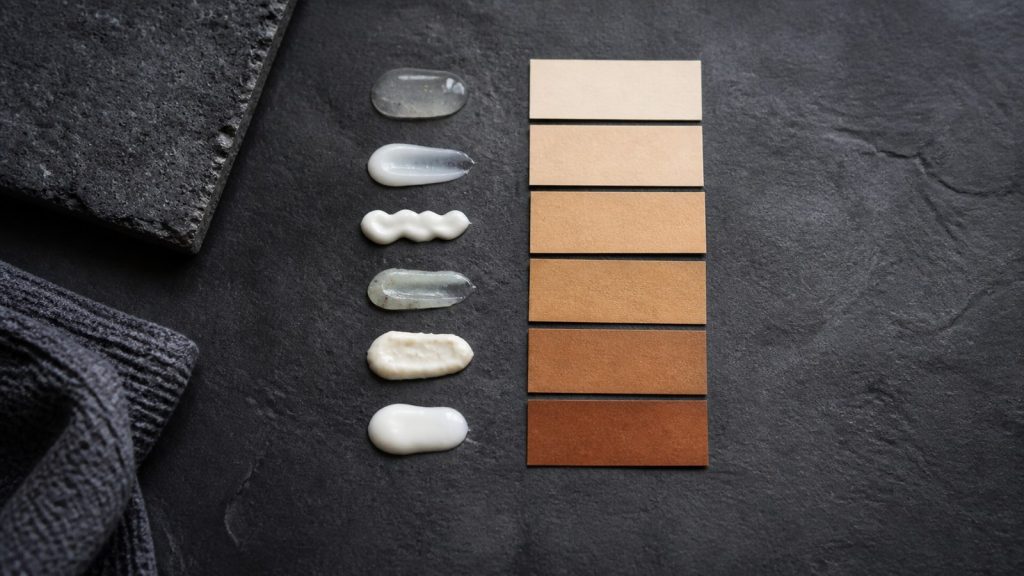
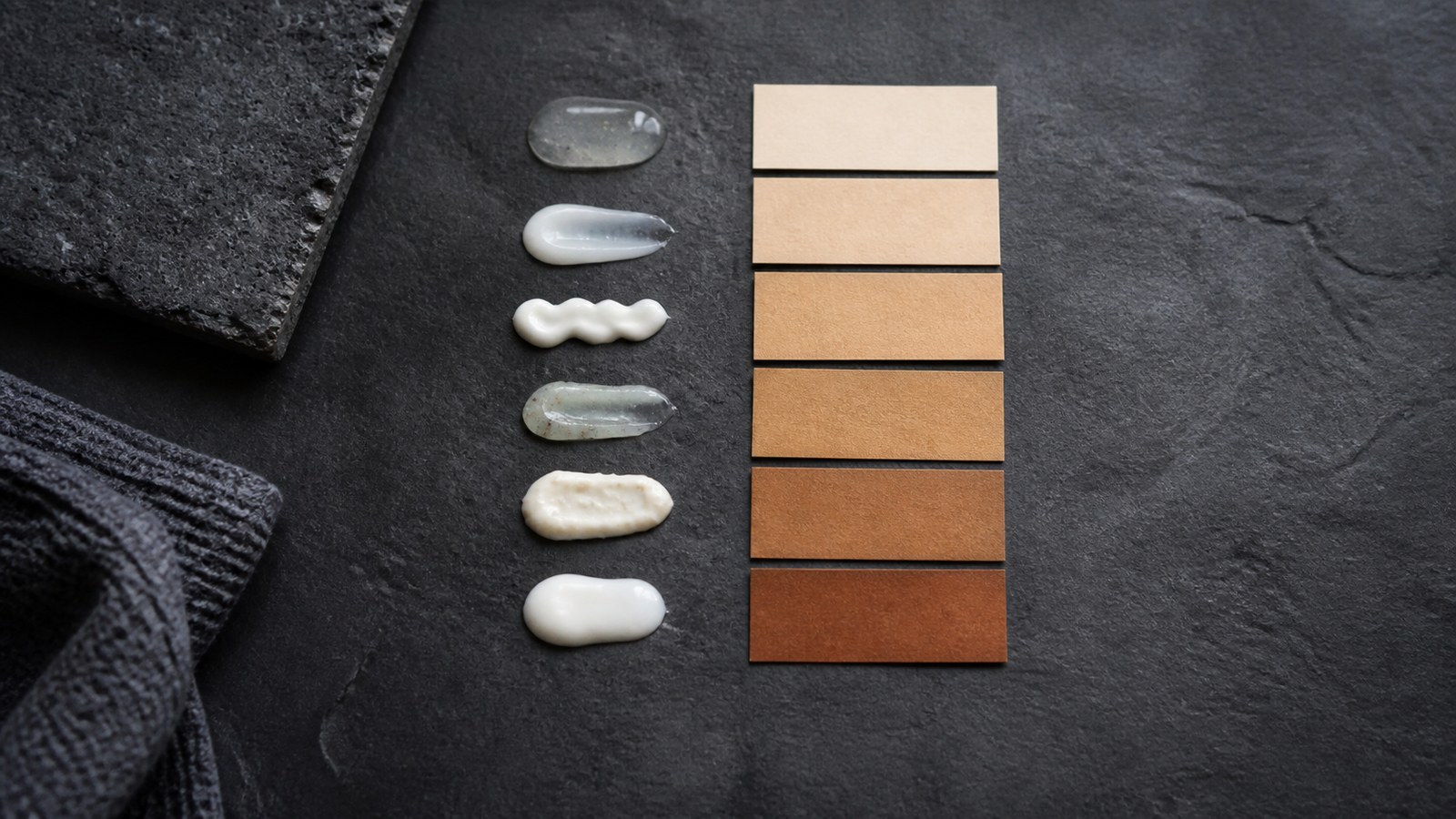
Two people who look similar in photographs: One person may burn easily before developing limited color, while the other may tan readily with little burning. Lighting, makeup, camera processing, white balance, recent tanning, and uneven pigmentation can make a picture-based comparison even less reliable. Charts showing the six basic skin types with pictures are educational illustrations, not diagnostic tools.
A reaction that changes after starting medication: Someone with a long history of tanning readily may begin burning more easily while using a photosensitizing medicine. The new reaction needs medical and medication context; it does not automatically prove that the constitutional type has changed.
These examples also show why the classification has clinical limits. A peer-reviewed review indexed by PubMed discusses limitations in applying Fitzpatrick typing across racially and ethnically diverse populations. Depending on the purpose, a clinician may consider treatment area, pigmentation history, recent exposure, medication use, and procedure-specific risk rather than treating one number as a complete assessment.
What to Decide Next
First decide which question you are actually trying to answer. If the question concerns sun response, consider the history of burning and tanning. If it concerns shine, tightness, flaking, comfort, or reactivity, read the facial baseline and current condition instead. Both descriptions can be useful at the same time.
Use these actions without turning self-classification into a deliberate exposure test:
- Recall your usual historical response when ordinary unprotected exposure happened in the past, but stop at an approximate answer if your memories are limited or inconsistent.
- Compare burning with tanning when choosing between adjacent phototypes, but do not let one unusually long or intense exposure outweigh the broader pattern.
- Observe separate facial zones across several ordinary days when identifying oil and barrier behavior, but postpone judgment after exercise, a hot shower, harsh cleansing, or a major weather change.
- Record a new photosensitive reaction when it follows medication or illness, but ask a clinician or pharmacist for context rather than assigning yourself a new permanent type.
Self-reading should stop when the number will influence a medical procedure or when symptoms exceed ordinary variation. Persistent burning, swelling, painful cracking, eye involvement, a spreading rash, recurring inflammation, or a new or changing lesion requires assessment by a qualified healthcare professional. This classification cannot diagnose a disease, and online guidance cannot replace individualized medical care.
The questions I wish I had asked sooner
Which type am I if I burn first but develop a tan later?
You may sit near the boundary between Type II and Type III. Type II generally burns easily and develops only a slight tan, whereas Type III may burn mildly or occasionally before producing a more noticeable tan. Use the frequency and consistency of past reactions rather than one severe exposure.
If the distinction will affect a procedure, let the treating professional assess it instead of testing the skin in sunlight.
Can a photograph accurately place me in one of the six types?
Not reliably. A photograph can show approximate visible pigmentation, but it cannot reveal how readily the skin burns or tans. Lighting, camera settings, makeup, recent tanning, and pigment changes can alter appearance. Use pictures only to understand the broad progression of the scale, not as the sole basis for assigning a phototype.
Why does my oily, dry, or combination skin not match my Roman numeral?
The labels measure different characteristics. Types I – VI summarize the tendency to burn and tan, while oily, dry, combination, balanced, and reactive descriptions concern oil production, barrier behavior, comfort, and current condition. There is no contradiction in having Type V combination skin, Type II oily skin, or Type IV skin that is temporarily dehydrated. Keep the two descriptions separate so each answers the question it was designed to address.
Back to top