Disclaimer: This guide on when to stop using skincare ingredients is for general education only and is not medical advice or a medical diagnosis. If you have burning, swelling, a rash, eye pain, vision changes, or symptoms that keep coming back, talk with a dermatologist, doctor, or qualified clinician.
The Short Answer
The short answer: I look at the exact moment the problem goes wrong, return to the last setup that felt safer, and pause anything that turns annoyance into damage, pain, or a bigger mess. I keep one detail honest: the exact moment it failed, what I had changed, and the limit that made me pause before I turned one problem into three.
The reason the first clue matters
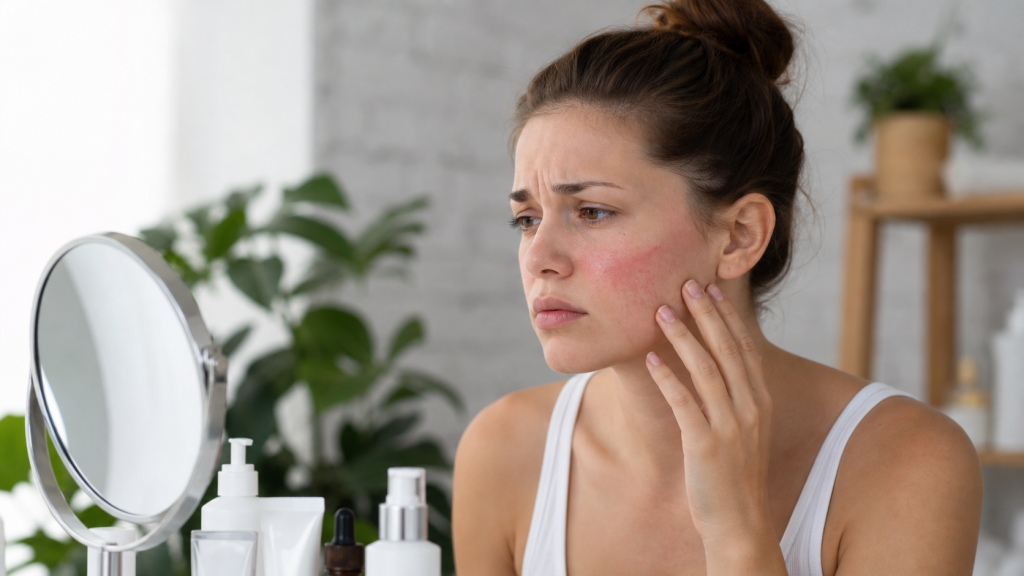
The moment I take seriously is not "my skin looks worse." It is the first observable shift: cleanser suddenly stings, cheeks feel hot after moisturizer, a serum that used to glide now drags and pills, or redness stays after the flush should have faded.
That is usually when I start asking the problem, because the answer is easier if I catch the first clue instead of waiting for my whole face to feel raw.
My messiest failure happened around day 10 of trying to make an active-heavy routine behave.
I had an L-ascorbic acid serum in the morning, a niacinamide serum that I kept layering because it felt harmless, an exfoliating acid at night, and a retinoid on the nights I thought my skin looked "dull." I also ignored the fact that the vitamin C had changed color from pale champagne to a deeper orange-brown and smelled sharper than it had
at first.
I told myself the warmth was a glow, then called the tiny bumps purging, then washed my face one night and felt a hot, bright sting across both cheeks. The next morning, my skin looked tight and shiny in patches, with flakes around my mouth that caught on every bit of moisturizer.
That first clue mattered because it gave me a timestamp. The burning did not appear after one plain moisturizer. It appeared after stacking too many actives, using a possibly oxidized serum, and pushing through irritation as if discomfort were proof of progress.
Purging is usually tied to certain ingredients that speed visible turnover, and even then it should not feel like a chemical burn.
Heat, sharp stinging, swelling, itchy welts, or redness that spreads beyond the application area is not a normal adjustment phase in my routine.
I also pay attention to texture changes in the product itself. A water-light serum turning sticky, a vitamin C darkening, an emulsion separating, or a dropper product smelling metallic can turn the skin problem into a formulation problem. That does not mean every color shift is dangerous, but it does mean I stop treating the bottle like a stable constant.
If the product has changed and my skin is also angry, I do not keep using it just to finish the money I spent. I have done that. The savings felt satisfying for two days; the burning redness cost me far more patience afterward.
The mistake that makes the usual fix backfire
On Day 1 after that day-10 burn, I stripped the routine back to the least dramatic version I could tolerate: gentle cleanse only if I needed it, plain moisturizer, and sunscreen in the morning.
I did not keep the vitamin C "because antioxidants are good." I did not keep the acid "because flakes need exfoliation." I did not keep the retinoid "because consistency matters." Consistency stops being useful when every step adds heat.
The awkward part was how unsatisfying this felt. My bathroom shelf looked like a row of sunk costs. I had paid for serums that were now just sitting there, and I had to resist the very specific urge to make one of them useful. I also had to deal with the texture of my face.
The flakes around my chin made foundation catch in dry islands, and the tightness after washing made me want to coat my skin in layers. But when I layered a water serum under an oilier cream too quickly, it pilled into little gray rolls along my jaw. I kept rubbing them off, which made the redness worse.
That was not skincare helping; that was friction.
The usual "add hydration" fix can fail when the order and base of the products fight each other. Water-based serums may not sit well over oily residue. Silicone-rich layers can roll if applied too soon after a tacky serum. Heavy occlusion over an active that is already irritating can make the sting feel trapped.
Even gentle products can hurt if the barrier is already reactive.
So I do not judge a step only by its reputation. I judge it by what happens in the next few minutes: does the heat climb, does tightness ease, does redness settle, or does my face feel like it is holding its breath?
That is also why I avoid swapping in three "repair" products at once. If my face calms down, I will not know which one helped. If it burns more, I will not know which one caused it. The broad reset feels productive because it gives me things to do, but too many changes blur the evidence.
The goal is not to build a prettier routine on Day 1.
The goal is to stop feeding the reaction.
The small move I test before touching the rest
By Day 3, I look for whether plain steps still sting. If cleanser no longer burns and moisturizer feels boring again, I stay boring a little longer instead of celebrating with an active. If redness is fading but flakes remain, I do not automatically exfoliate them.
I let them shed because forced smoothness is how I have turned a recovering patch into a glossy, tender one.
The narrow action I use is simple, but I keep it strict: I choose only one suspect ingredient to keep paused, leave the quiet routine alone, and observe the same moments each day. I check how my skin feels after rinsing, five minutes after moisturizer, and later in the day when sunscreen or sweat has been sitting on it.
I do not need a complicated journal, but I do need enough detail to avoid lying to myself. "Fine" is not useful. "Left cheek stung for 20 seconds after moisturizer, no heat after that" is useful.
By Day 7, if my skin is calm enough that washing and plain moisturizer do not hurt, I consider a small reintroduction. I do not reintroduce the whole stack. I pick one product, use a tiny amount on a small area such as the lower cheek or jawline, and wait to see what happens through the next day.
If that area gets hot, itchy, bumpy, or sharply red, I do not expand it to my whole face. If it stays quiet, I still avoid pairing it immediately with another active.
This is where ingredient behavior matters. L-ascorbic acid can be fussy about stability, packaging, air exposure, and color shift. Exfoliating acids and retinoids can both push irritation if I overlap them too soon. Niacinamide is often tolerated, but it is not magic armor against every active layered underneath or on top.
Oil and water layers can also block, dilute, pill, or trap in ways that make the routine feel unpredictable. Timing gaps help, but they are not a cure for a stack that my skin cannot tolerate.
The reintroduction phase is physically annoying. I have stood in a small bathroom with sunscreen half-set on my face, waiting because a serum underneath was still tacky. I have gone to bed with only moisturizer while the expensive retinoid sat unused, which felt like wasting progress.
I have also dabbed a test patch near my jaw and then spent the evening trying not to touch it every ten minutes. That friction is part of the process. A narrower test protects me from turning curiosity into another full-face setback.
The line where I get help outside my own guesswork
I stop treating it as routine troubleshooting when symptoms move from annoying to unsafe-feeling or persistent. Burning that keeps returning with bland products, swelling, hives, oozing, crusting, eye-area pain, spreading rash, or redness that feels hot and does not settle are signs I should not keep experimenting.
If my skin hurts when water touches it, I am past the point where another serum comparison will help.
I also get outside help when the repeat I finally trusted repeats after careful reintroduction. If one acid always causes a hot flush, if vitamin C burns even after the barrier feels calm, or if a retinoid keeps triggering peeling that cracks at the corners of my mouth, I do not keep forcing a tolerance story.
A clinician can help sort irritation, allergy, dermatitis, acne flare, rosacea-like sensitivity, or another issue that I cannot confirm by staring at my bathroom mirror.
The boundary is even clearer near the eyes, lips, or broken skin. I do not test actives on eyelids, raw patches, or areas that are already split. I do not try to outsmart swelling with timing gaps.
And I do not keep using a product that has obviously changed smell, color, or texture while my skin is reacting, especially if it is an active serum that depends on stability.
The useful lesson from my day-10 collapse was not that every active is bad. It was that my skin gave me smaller warnings before it gave me a bigger one. Heat after application, cleanser sting, lasting redness, changed serum color, pilling from rushed layers, and flakes that I tried to polish away were all pieces of the same answer.
When the routine starts producing pain instead of mild, temporary adjustment, I pause the likely irritants, keep the boring supports, and stop guessing when the reaction is bigger than my ability to track it safely.
The questions I wish I had asked sooner
I added a new serum three nights ago and the texture now pills under moisturizer. What should I test before blaming the whole routine?
I would remove only the newest layer first and keep the rest unchanged for a few nights. If the pilling stops, I re-test with less product or a longer wait time before deciding the ingredient itself is wrong for me.
My routine looks fine on paper but one layer feels tacky for hours, and I'm worried the formulas are clashing. Where do I start?
I start with texture and timing, not another active. I apply the watery step alone, then the cream alone, and watch whether the tackiness appears only when the two sit together.
The product color changed slightly after a few weeks, and I'm not sure if my skin is reacting or the formula changed. What would you do?
I would pause that product and compare the smell, color, and texture with how it looked when it was new. If oxidation or separation is obvious, I do not keep testing it on my face just to prove a point.
Quick Summary
- First clear warning sign: I pause the newest change when the label, routine, or product layer makes the repeat I finally trusted harder to read.
- Reset move: I go back to the last boring setup that stayed calm before testing one suspected trigger.
- Stop line: I stop guessing at home if discomfort spreads, daily use gets harder, or a qualified clinician is the safer next step.