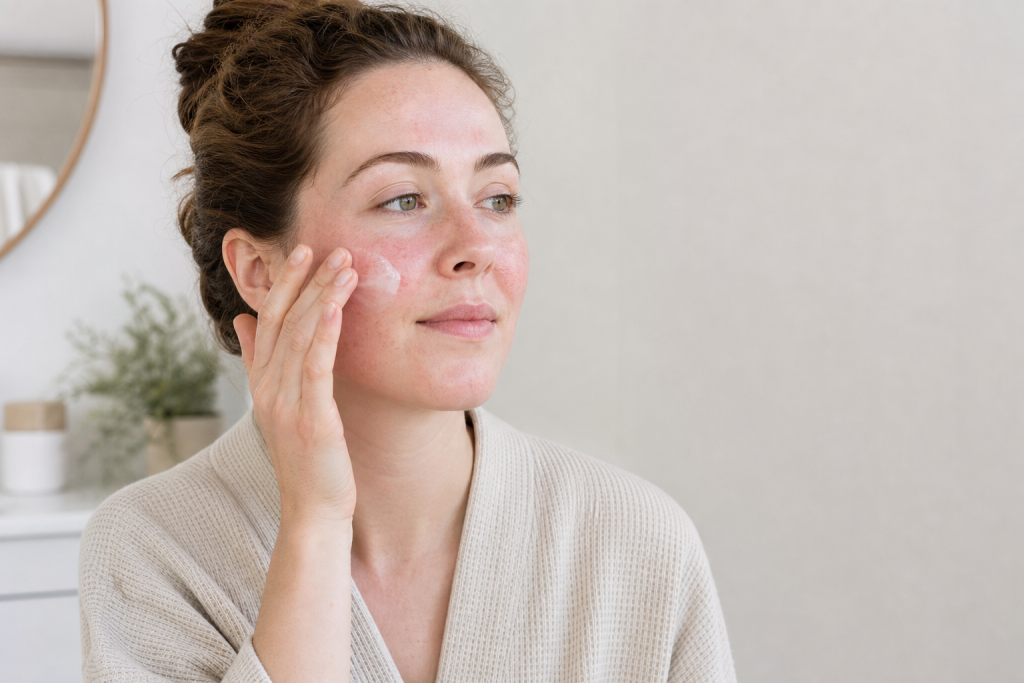
*By Mara Ellis, Skincare Research Editor*
Disclaimer: This guide on how to use sensitive skin is for general education only and is not medical advice or a medical diagnosis. If you have burning, swelling, a rash, eye pain, vision changes, or symptoms that keep coming back, talk with a dermatologist, doctor, or qualified clinician.
The Short Answer: Use Sensitive Skin Products Slowly, Simply, and One at a Time
To use sensitive skin products well, keep the routine plain, introduce only one new product at a time, and watch how your skin reacts over several days. The goal is to reduce common triggers, support the skin barrier, and avoid guessing which cleanser, moisturizer, sunscreen, serum, or acne treatment caused stinging, redness, itching, burning, tightness, or bumps.
Sensitive skin care is less about finding a "miracle" product and more about controlling variables. If your face burns after washing, flushes after a vitamin C serum, or feels tight under sunscreen, your skin may be reacting to fragrance, exfoliating acids, retinoids, drying cleansers, high-alcohol formulas, or simply too many active ingredients at once.
A slower routine gives your barrier a chance to stay calm while you identify what your skin can tolerate.
Start with the smallest useful routine:
- A gentle, non-scrubbing cleanser, or just a water rinse in the morning if cleansing twice daily feels drying.
- A bland moisturizer with barrier-supporting ingredients such as ceramides, glycerin, petrolatum, dimethicone, or colloidal oatmeal.
- A broad-spectrum sunscreen in the morning, chosen for comfort as much as protection.
That simple structure matters because the skin barrier is your first line of defense. When it is disrupted, water escapes more easily and irritants enter more easily, which can make ordinary products feel sharp, hot, or itchy.
The American Academy of Dermatology emphasizes gentle daily care basics such as mild cleansing, moisturizing, and sun protection, which are especially important when your skin is reactive (AAD).
When adding a new product, change one thing and leave everything else the same. For example, if you want to try a niacinamide serum, do not also switch cleansers, add a retinoid, start exfoliating pads, and test a new sunscreen in the same week. If your cheeks sting on day three, you will not know which product did it.
Instead, apply the new product to a small area first, then use it every other day or a few times weekly before increasing.
A practical sensitive-skin testing approach can look like this:
- Test the product on a small area near the jaw, behind the ear, or on the side of the neck for several days.
- If there is no burning, swelling, rash, or persistent itching, apply it to one facial zone before full-face use.
- Use leave-on actives at night at first, especially retinoids, exfoliating acids, or acne treatments.
- Keep moisturizer available so you can buffer stronger products or reduce dryness.
- Stop the product if irritation is intense, spreading, or worsening instead of settling.
For a reader with oily but reactive skin, "simple" does not mean skipping moisturizer. It may mean choosing a lightweight gel-cream without fragrance and using a gentle foaming cleanser only once nightly. For a reader with dry, redness-prone skin, it may mean a creamy cleanser, a richer moisturizer, and avoiding scrubs or strong acids.
For someone who breaks out easily, it may mean using acne treatments cautiously rather than layering benzoyl peroxide, salicylic acid, retinoids, and exfoliating toner all at once.
Sunscreen is often where sensitive skin routines fail because even a good formula can sting, pill, or clash with moisturizer.
If your sunscreen balls up, flakes, or feels gritty, the issue may be layering, dry skin, too much product rubbed in aggressively, or formulas that do not sit well together; problems like when sunscreen pills on your skin are usually easier to solve once the rest of the routine is stable.
If makeup is part of your day, sunscreen comfort also affects whether you can reapply it consistently, especially when learning how to reapply sunscreen over makeup without irritating your face.
The safest mindset is: cleanse gently, moisturize consistently, protect from sun, then add targeted products slowly. If your skin keeps reacting despite a stripped-down routine, or if you have swelling, cracking, oozing, hives, or severe burning, pause experiments and talk with a dermatologist or qualified clinician.
Sensitive skin can overlap with eczema, rosacea, acne, allergic contact dermatitis, or medication-related irritation, so persistent reactions deserve more than another random product swap.
What Sensitive Skin Usually Means
Sensitive skin is not one single skin type or a diagnosis by itself. In everyday skincare, it usually means your skin reacts more easily than you expect to products, weather, friction, or routine changes. A cleanser that feels fine on someone else may sting on you. A moisturizer may leave your cheeks hot and red.
A sunscreen may feel prickly around your nose or eyes, even when the label says it is gentle.
The most common pattern is product intolerance: your skin seems to have a short patience window. You may be able to use a basic moisturizer, but not a fragranced cream. You may tolerate one sunscreen, then burn or flush when you try a new one.
You may notice that actives such as retinoids, exfoliating acids, benzoyl peroxide, or strong vitamin C products make your face feel tight, shiny, itchy, or raw after a few uses.
People often describe sensitive skin with sensations rather than visible signs. Common experiences include:
- Stinging or burning after applying cleanser, serum, moisturizer, sunscreen, or makeup
- Redness that appears quickly after washing, rubbing, shaving, or using a new product
- Dryness, flaking, or rough patches that return even with moisturizer
- Tightness after cleansing, especially around the cheeks, mouth, or forehead
- Itching or prickling without an obvious rash
- Frequent irritation from fragrance, essential oils, scrubs, acne treatments, or exfoliating toners
- Skin that feels fine one week and reactive the next after travel, cold weather, heat, or over-cleansing
This is why the question is usually less "Do I have sensitive skin forever?" and more "What can my skin tolerate right now?" Skin can become temporarily sensitive when its outer barrier is stressed. Over-washing, using too many treatment steps, layering several exfoliants, starting a retinoid too quickly, shaving closely, or skipping moisturizer can make skin more reactive.
Cold wind, dry indoor air, sweating under a mask, and frequent sun exposure can also lower tolerance.
For example, someone with oily, acne-prone skin may still be sensitive if acne washes leave their face burning and peeling. Someone with dry skin may react to foaming cleansers because they remove too much oil. Someone who wears makeup daily may find that long-wear foundation, makeup removers, and sunscreen layered together make the skin around the eyes and mouth sting by evening.
Sensitive skin can overlap with many routines; it is not limited to dry or fair skin.
It is also important not to overdiagnose every reaction. A brief tingle from one product is different from swelling, hives, crusting, blistering, or a rash that spreads. Persistent burning, painful redness, or irritation that does not improve after simplifying your routine deserves professional care.
The American Academy of Dermatology offers practical skin-care basics, and a dermatologist can help sort out whether you are dealing with irritation, allergy, eczema, rosacea, acne treatment side effects, or another condition.
In routine terms, sensitive skin asks for fewer experiments and more observation. Instead of judging a product only by claims such as "clean," "natural," "active," or "dermatologist-tested," pay attention to how your skin feels 10 minutes later, the next morning, and after several uses.
The FDA cosmetics information can be useful background because cosmetic labels do not guarantee that a product will suit every reactive face.
A helpful way to think about sensitive skin is that it behaves like a warning system. Stinging, tightness, and repeat redness are signals to slow down, simplify, and introduce products one at a time.
Learning how to use sensitive skin as feedback can make your routine more predictable: keep the steps bland, protect the barrier, avoid piling on strong actives, and treat comfort as a real measure of whether a product belongs on your face.
How to Build a Simple Sensitive Skin Routine
A sensitive skin routine works best when it is boring in the right ways: a mild cleanser, a barrier-supporting moisturizer, daily sunscreen, and only one optional treatment at a time. If your cheeks sting after washing, your eyelids get dry from new creams, or your skin turns red when you layer several "calming" products, the goal is not to find more products.
The goal is to lower the number of possible triggers while keeping the skin clean, hydrated, and protected.
Start with a cleanser that removes sweat, sunscreen, and light makeup without leaving your face tight. For most sensitive skin, that means a fragrance-free cream, lotion, milk, or low-foam gel cleanser. Use lukewarm water and your fingertips instead of a scrub brush or rough cloth.
In the morning, some people only need a water rinse, especially if their skin is dry or reactive. At night, cleanse once; if you wear long-wear sunscreen or heavy makeup, use a gentle cleansing balm first and follow with a mild cleanser only if your skin tolerates it.
Moisturizer is the anchor of the routine. Apply it while the skin is slightly damp so it can reduce water loss and soften rough patches. Look for simple formulas with ingredients such as glycerin, petrolatum, dimethicone, ceramides, squalane, or colloidal oatmeal. A lightweight lotion may suit oily but reactive skin, while a thicker cream may suit dry, flaky, or winter-irritated skin.
If your face burns when you moisturize, switch to a shorter ingredient list and avoid fragrance, essential oils, exfoliating acids, and "warming" or "cooling" sensations.
A basic routine can look like this:
- Morning: rinse or cleanse gently, apply moisturizer, then apply broad-spectrum SPF 30 or higher.
- Evening: cleanse gently, apply moisturizer, and stop there if the skin feels irritated.
- During flares: pause optional treatments and use only cleanser, moisturizer, and sunscreen until the skin feels comfortable again.
Sunscreen is not optional for sensitive skin, but the formula matters. Mineral sunscreens with zinc oxide or titanium dioxide are often a good starting point for people who sting with chemical filters, although texture and finish vary widely. Apply enough to cover the face, ears, and neck, then give it time to settle before makeup.
If layering causes rolling or flakes, the issue may be product compatibility rather than sensitivity; a practical explanation of why sunscreen can pill can help you adjust moisturizer amount, wait time, or formula texture.
Optional treatments should enter slowly. This is where many sensitive routines fall apart. Retinoids, vitamin C serums, benzoyl peroxide, salicylic acid, glycolic acid, and even some "barrier repair" serums can irritate if introduced too quickly. Choose one concern first: acne, dullness, dark marks, or texture.
Use the treatment two nights per week for two weeks, then increase only if your skin stays calm. The American Academy of Dermatology recommends keeping skin care simple and choosing products carefully when irritation is a concern, which fits the approach of adding only what your skin can prove it tolerates through consistent use AAD.
For example, if you have acne and sensitive skin, you might use a gentle cleanser, a non-comedogenic moisturizer, sunscreen in the morning, and a low-strength acne treatment only on Monday and Thursday nights. If you are dealing with dryness and redness after trying several actives, remove the treatment step for two weeks and focus on barrier comfort.
If you are learning the products in your routine after a reaction, patch test a new item on the side of the neck or jaw for several days before applying it to the full face.
Keep the routine consistent for at least two to four weeks before judging results, unless a product causes burning, swelling, hives, or worsening rash. The most useful routine for sensitive skin is not the one with the most soothing claims; it is the one your skin can tolerate daily without stinging, tightness, or repeated redness.
How to Make a Better Decision About New Skincare Products
When your skin stings easily, turns red after cleansing, or tolerates one moisturizer but rejects the next, buying skincare should feel less like guessing and more like screening. A better decision starts before the product touches your face: compare the formula, the promise, the format, and the risk of irritation in the context of your current routine.
Start with ingredient simplicity. A product with 10 to 20 ingredients is not automatically safer than one with more, but shorter formulas can make it easier to identify what your skin likes or dislikes.
If you are learning the timing products without triggering a flare, choose one new item at a time and favor formulas built around familiar support ingredients such as glycerin, petrolatum, dimethicone, colloidal oatmeal, panthenol, squalane, or ceramides. The broader habits that support sensitive skin also matter: gentle cleansing, steady moisturizing, and fewer overlapping actives.
Be skeptical of dramatic claims. "Dermatologist-tested," "clean," "hypoallergenic," and "for all skin types" can be helpful clues. But they do not guarantee your skin will tolerate the formula.If a serum claims to erase texture overnight or a cream promises instant barrier repair, compare that promise with the ingredient list and the concentration of potentially irritating actives.
Use this practical filter before adding a product to your cart:
- Ingredient simplicity: Does the formula avoid a long mix of essential oils, fragrant extracts, dyes, and multiple acids if your skin is reactive?
- Claim quality: Does the product make a realistic claim, such as "helps moisturize dry skin," rather than a sweeping promise like "resets your skin barrier in one use"?
- Format: Is it a cream, balm, lotion, gel, toner, pad, or spray? Leave-on liquids and exfoliating pads often feel stronger than a rinse-off cleanser.
- Fragrance: Is it fragrance-free, or does it include perfume, essential oils, citrus oils, lavender, peppermint, or botanical scent blends?
- Active strength: Does it disclose the percentage of ingredients such as retinol, benzoyl peroxide, salicylic acid, glycolic acid, lactic acid, vitamin C, or urea?
- Patch testing: Can you test it behind the ear, along the jaw, or on the side of the neck for several days before using it widely?
- Return policy: Can you return it if it causes stinging, rash, swelling, or repeated breakouts despite careful use?
Match the product to the problem you are solving. If your cheeks burn after washing, do not start with a resurfacing toner; compare creamy cleansers or non-foaming gels first. If your moisturizer pills under SPF, the issue may be layering, dry-down time, or silicone-heavy formulas, so troubleshooting why sunscreen pills on your skin may be more useful than buying another active serum.
If makeup is part of your day, a product decision should also consider reapplication, because learning how to reapply sunscreen over makeup can prevent you from overloading your morning routine with incompatible layers.
Active ingredients need extra caution. A 10% niacinamide serum, a 2% salicylic acid leave-on, a strong vitamin C serum, or a retinoid can be reasonable for some people, but they are not "gentle" just because the bottle says sensitive.
The American Academy of Dermatology emphasizes basic skincare habits such as gentle cleansing, moisturizing, and sun protection, which are often the foundation before stronger treatments. For acne-prone skin, check whether the product is a cosmetic, an over-the-counter drug, or a prescription-adjacent treatment; the FDA's guidance on over-the-counter medicines is useful when you are comparing medicated acne products.
Finally, decide with a "one change" rule. If you buy a new cleanser, moisturizer, and exfoliant on the same day, you will not know which one caused the burning or bumps. Introduce the lowest-risk product first, use it consistently, and wait before adding the next.
A boring product that your skin tolerates is usually a better purchase than an exciting product you can only use twice.
When to Stop Comparing and Decide
Sensitive skin does not reward endless product testing. At a certain point, the best choice is not the serum with the longest ingredient story or the moisturizer with the most glowing reviews. It is the plain, fragrance-free product your skin can use repeatedly without stinging, flushing, itching, tightness, peeling, or new bumps.
A good stopping point is when a product meets three practical standards: it supports the routine step you need, it avoids obvious irritant triggers, and your skin tolerates it for at least two weeks of steady use. For a cleanser, that may mean your face feels clean but not squeaky or tight.
For a moisturizer, it may mean your cheeks stop feeling rough by midafternoon. For sunscreen, it may mean you can apply enough product without burning, tearing, or wanting to wash it off immediately.
This matters because sensitive skin often becomes more reactive when the routine keeps changing. Switching from one "calming" toner to another, layering three barrier creams, or testing a new exfoliating acid every weekend can make it impossible to know what actually caused the burning. Even gentle-looking products can irritate when they are stacked together too quickly.
A basic option is usually good enough when:
- It is fragrance-free, not just labeled "clean" or "natural."
- It has a short, understandable role in your routine: cleanse, moisturize, protect, or treat.
- It does not cause immediate stinging that lasts beyond a few minutes.
- It does not create a delayed flare over the next day or two.
- It fits your real life, including your budget and how often you will actually use it.
For example, if you have found a cream cleanser that does not leave your skin tight and a bland moisturizer that keeps flakes down, you do not need to keep searching for a "better barrier routine" because another formula has ceramides, peptides, or a prettier texture.
If your current sunscreen is fragrance-free and wearable, focus on applying enough and reapplying when needed rather than buying five more bottles. If texture issues are the problem, details such as whether sunscreen pills on your skin may matter more than chasing a stronger active ingredient.
This is especially important when you are trying to learn the products your skin is reacting to without setting off a reaction. Add one product at a time, keep the rest of the routine boring, and give your skin enough time to show a pattern.
The American Academy of Dermatology emphasizes simple skin care basics for everyday routines, which is often the most realistic approach for reactive skin.
A common scenario: your skin is dry, red around the nose, and easily irritated after washing. You compare gel moisturizers, barrier balms, milky toners, and overnight masks. The decision point is not which one has the most advanced ingredients. The decision point is whether one fragrance-free moisturizer can be used morning and night without making the redness worse.
If yes, stop there for now.
Another scenario: you want brighter skin, but vitamin C serums keep stinging. Instead of trying every low-pH antioxidant serum, choose sunscreen consistency first. Daily UV protection can help prevent uneven tone from worsening, and it is usually more important than forcing a brightening active onto irritated skin.
If you wear makeup, a practical plan for reapplying sunscreen over makeup may protect your skin better than another treatment serum.
Be cautious with labels that sound reassuring but do not guarantee tolerance. "Dermatologist tested," "hypoallergenic," and "for sensitive skin" can be helpful clues. But they do not replace your own patch test or gradual introduction.If you are stuck comparing two similar fragrance-free moisturizers, choose the one with fewer extras, easier access, and a texture you will use daily.
If you are choosing between a mild cleanser that works and a trending cleanser with exfoliating acids, keep the mild one.
If your skin is currently flaring, do not use that week to test a new active, scrub, mask, or peel.
The goal with sensitive skin is not to build the most impressive shelf. It is to build a routine your skin can predict. Once you have a cleanser, moisturizer, and sunscreen that behave well, the smartest decision may be to stop comparing, stop adding, and let your skin stay calm long enough to recover.
When Sensitive Skin Needs Professional Help
A careful routine can reduce stinging, redness, and product intolerance, but sensitive skin is not always something to troubleshoot at home. If your skin reacts severely, keeps flaring despite a simple routine, or starts to look infected, it is time to contact a dermatologist or healthcare professional.
The goal is not just to calm the surface; it is to identify whether you are dealing with irritant dermatitis, allergic contact dermatitis, eczema, acne, rosacea, infection, or another condition that needs targeted care.
Seek urgent medical help if a skincare product triggers symptoms beyond mild burning or temporary redness. Stop using the product immediately and get professional advice if you notice:
- Rapid swelling of the face, lips, eyelids, or throat
- Trouble breathing, wheezing, dizziness, or faintness
- Blistering, open sores, or a widespread rash
- Severe pain, intense itching, or skin that feels hot and tender
- Hives that spread quickly or involve more than one area of the body
These signs may point to a serious allergic reaction or a severe inflammatory response.You should also book a dermatology appointment if your "sensitive skin" behaves like eczema. Examples include dry, cracked patches that return in the same areas, itchy eyelids after using eye cream, rough red skin around the mouth, or hand irritation from repeated cleansing.
A dermatologist can check whether fragrance, preservatives, botanical extracts, lanolin, sunscreen filters, or topical medications are triggering allergic contact dermatitis. Patch testing may be recommended when reactions keep happening even after switching to gentle products.
Persistent acne is another reason to get help, especially if your skin cannot tolerate common over-the-counter options. If benzoyl peroxide burns, salicylic acid makes your face peel, or every moisturizer seems to clog pores, you may need a lower-irritation acne plan rather than more trial and error.
The American Academy of Dermatology acne resource outlines treatment approaches, but a dermatologist can personalize them for skin that is both acne-prone and reactive.
Call a healthcare professional promptly if you see possible infection signs. Sensitive or damaged skin has a weaker barrier, which can make irritation worse and allow bacteria to enter.
- Yellow crusting, pus, or honey-colored scabs
- Increasing warmth, swelling, or tenderness
- Red streaks moving away from the affected area
- Fever, chills, or feeling unwell
- A painful rash near the eyes, nose, or mouth
Do not cover these symptoms with heavy ointments, makeup, exfoliating acids, or acne spot treatments while waiting. Keep the area clean, avoid picking, and seek care.
Professional help is also appropriate when irritation does not improve after a true reset. If you have stopped exfoliants, retinoids, vitamin C, fragranced products, scrubs, masks, and new actives for one to two weeks but your skin still burns with water or bland moisturizer, that is not normal product adjustment.
It may be barrier damage, dermatitis, rosacea, seborrheic dermatitis, or another condition that needs diagnosis.
Bring details to your appointment so the clinician can see the recurring pattern. List every cleanser, moisturizer, sunscreen, serum, acne treatment, prescription cream, and hair product touching your face or neck. Note when symptoms began, what improves them, and whether flares happen after sunscreen, makeup, shaving, masks, workouts, or weather changes.
Photos from flare days can help because skin may look calmer by the appointment.
If you are learning the products in your routine safely, professional guidance can prevent repeated reactions and unnecessary product switching. A dermatologist may suggest a bland barrier-repair routine, prescribe anti-inflammatory treatment, adjust acne medication strength, or recommend specific allergen avoidance.
For everyday care basics, the American Academy of Dermatology offers patient guidance, and a focused routine for sensitive skin can support the plan once serious triggers are ruled out.
How to Use Sensitive Skin: At-a-Glance Decision Guide
| What you notice | What it may mean | Better next move |
|---|---|---|
| Stinging, heat, or raw tightness | The skin barrier may be irritated | Pause strong actives and simplify the routine |
| Pilling, patchiness, or uneven wear | Layering, amount, or texture may be the issue | Use less product and wait longer between layers |
| Breakouts in familiar zones | The routine may need time or one targeted active | Track timing before changing several products |
| Swelling, spreading rash, or pain | This may need medical judgment | Stop experimenting and contact a qualified clinician |
Frequently Asked Questions
What matters most when building a routine for sensitive skin?
The most important goal is reducing irritation while still helping your skin barrier do its job. A good routine for sensitive skin usually starts with a gentle cleanser, a simple moisturizer, and daily sunscreen before adding treatments.
Compare options by asking:
- Does this product solve the main concern without adding unnecessary fragrance, harsh exfoliants, or too many active ingredients?
- Can I introduce it slowly enough to spot delayed reactions?
- Would redness, stinging, tightness, or breakouts make it hard to tell whether the product is helping or hurting?
Guidance from the American Academy of Dermatology can help you keep the routine basic, consistent, and easier to troubleshoot.
How do I compare sensitive-skin products quickly?
Start by removing anything that fails your must-have requirement: low irritation risk. Then compare what remains by texture, ingredient list, price, return policy, and how easily it fits your current routine.
For most people, the safer shortlist includes:
- Fragrance-free cleanser
- Barrier-supporting moisturizer
- Broad-spectrum sunscreen
- One treatment product at a time, if needed
If a product requires several extra steps, causes frequent pilling, or does not layer well, it may be harder to use consistently. If sunscreen texture is the issue, the problem may be layering rather than sensitivity; sunscreen pilling can often come from product order, amount, or dry-down time.
When is the cheaper option good enough for sensitive skin?
A cheaper option is good enough when it cleanses, moisturizes, or protects without causing stinging, burning, lingering redness, or a tight feeling. Sensitive skin does not always need premium products; it often needs fewer irritants and a predictable formula.
The lower-cost choice is usually reasonable if:
- It is fragrance-free or clearly labeled for sensitive skin
- It has a simple formula with no obvious personal triggers
- It performs the main job without extra steps
- You can replace it easily without changing the whole routine
A more expensive product is not automatically gentler, so judge it by tolerance and consistency rather than branding.
What warning signs should make me pause or stop using a product?
Pause if a product causes burning, swelling, hives, intense itching, peeling that feels painful, or redness that keeps getting worse. Mild tingling from some active ingredients can happen, but discomfort should not be treated as proof that a product is working.
Also be cautious when a recommendation relies on vague claims like "detox," "purging," or "medical-grade" without explaining who it suits and what reactions to expect.### How much do reviews matter when my skin reacts easily?
Reviews are useful only when they match your situation. A five-star review from someone with oily, resilient skin may not tell you much if your skin is dry, reactive, or barrier-damaged.
Look for reviews that mention:
- Skin type and sensitivity level
- How long the reviewer used the product
- Whether irritation appeared immediately or after several days
- How the product layered with sunscreen or makeup
- Whether the reviewer changed other products at the same time
Ignore reviews based only on first impressions, scent, packaging, or a single use.
Should I choose the most popular sensitive-skin product?
Not automatically. Popular products can be good starting points, but the better choice is the one that fits your skin's actual limits. If your routine already includes acne treatments, exfoliating acids, retinoids, or prescription products, even a popular formula may be too much when layered incorrectly.
If acne is part of the decision, the American Academy of Dermatology Acne Resource can help you understand when breakouts may need a different approach. The right product should make your routine easier to follow, not harder to interpret.
What should I check after first use?
After first use, check whether the product did the job without creating a new problem. For sensitive skin, it is usually better to test one new product at a time and wait long enough to notice delayed reactions.
Track simple details such as:
- Redness, itching, burning, or tightness
- Dry patches or flaking
- New bumps or clogged pores
- How the product feels after several hours
- Whether sunscreen or makeup still applies smoothly
If the product works but your sunscreen routine is difficult over makeup, learning how to reapply sunscreen over makeup may solve the practical issue without changing the entire routine.
Final Thoughts
The best way to use products on sensitive skin is to keep the routine simple, introduce changes slowly, and judge each product by comfort, consistency, and clear results rather than popularity or marketing claims.
Back to top